For twenty years, static application security testing meant the same thing: parse the code, walk a few graphs, match it against a rulebase, and hand the developer a list. The list was always too long. In 2025 a Ghost Security scan of public GitHub repositories put a number on the pain that every AppSec lead already felt in their gut: of 2,116 findings flagged by traditional SAST, only 180 were real, a false-positive rate of roughly 91%. That is not a tuning problem. It is the structural limit of a technique that flags patterns instead of understanding programs.
The pitch for AI-powered SAST is that it does the second thing. Instead of asking "does this line match a dangerous shape," it asks "can untrusted input actually reach this sink, under which conditions, and does the result matter." The early evidence is striking: vendors combining a deterministic engine with LLM reasoning report false-positive reductions of 85% to over 90%, and reachability-aware triage that removes up to 98% of the noise on high-severity dependency findings. But "AI" is also the most abused word in the security market right now, and a lot of what ships under that banner is a thin wrapper around the same old rulebase.
This is a two-layered breakdown. The first part is for the person who has to decide, this quarter, whether to keep paying for the scanner that nobody reads, whether "AI SAST" is a real category or a rebrand, and what to actually do on Monday. The second part dissects how each approach works under the hood: the AST-to-taint pipeline that classic SAST runs, the precise places it goes blind, and how semantic reasoning and reachability change the math. The article closes by looking at how the Pragma Core platform applies this class of analysis in practice, because Pragma Core is itself an AI-driven SAST, and the honest version of that story is more useful than the brochure one.
Part I. Executive breakdown
What happened
Nothing "happened" in the sense of a single disclosure. What happened is slower and more important: the dominant way organizations look for bugs in their own code stopped scaling with the code.
Classic SAST works like a very thorough proofreader who has memorized a list of forbidden phrases. It reads every line, and whenever it sees something that looks like a known-dangerous shape, a call to a function that can run shell commands, a string that gets concatenated into a query, a hardcoded password, it raises its hand. This is fast, it is repeatable, and for the most obvious mistakes it works. The problem is that the proofreader does not understand the story. It cannot tell whether the dangerous-looking phrase is actually reachable, whether the input was already cleaned three functions ago, or whether a perfectly innocent-looking line is in fact a serious flaw because of something happening in a different file. So it does two things badly at once: it shouts about thousands of things that are fine (false positives), and it stays silent about real bugs that do not match any phrase on its list (false negatives).
AI-powered SAST changes the proofreader into something closer to a reviewer who actually reads for meaning. It still uses the fast pattern engine as a first pass, but then it reasons about the code the way a human security engineer would: it follows the data, asks who calls this and with what, checks whether the authorization that should be there is actually there, and decides whether a given finding is exploitable in context. The concrete result for a team is fewer alerts, but more of them true, and a meaningful number of bugs surfaced that the old tool would never have named, the logic flaws, the missing access checks, the bugs that live in the relationship between functions rather than on any single line.
Who is affected
This is less "who is vulnerable" and more "where each approach earns its keep." The honest answer is that it is not a clean replacement; it is a shift in the center of gravity.
| Approach | What it does well | Where it breaks |
|---|---|---|
| Classic SAST (rule and taint based) | Fast, deterministic, cheap to run on every commit; reliable on syntactic bugs (injection sinks, banned APIs, hardcoded secrets); auditable rules | Drowns teams in false positives; blind to business-logic and authorization bugs; rulebase lags new frameworks; no notion of exploitability |
| AI-powered SAST (engine plus LLM reasoning) | Reasons about intent and data flow across files; cuts false positives sharply; catches logic and access-control flaws; explains and often fixes findings | Non-deterministic outputs; can hallucinate or miss without grounding; cost and latency per finding; "AI" label often oversold |
| The two combined | Deterministic engine for recall and speed, reasoning layer for precision and context: the pattern most serious tools now converge on | Requires real engineering, not a prompt; quality depends entirely on how the reasoning is grounded in the actual codebase |
The number that should focus the mind is not the 91% noise figure on its own. It is what that noise does to people. One widely cited estimate puts the average enterprise at over 865,000 security alerts per year, of which fewer than 800 are genuinely critical once exploitability and reachability are applied. A team that triages by hand cannot win that fight. They stop reading the scanner. The expensive tool becomes a compliance checkbox, and real bugs sit in the backlog behind nine hundred false ones.
Why this matters beyond any one scanner
The deeper issue is that modern software broke the assumption classic SAST was built on. Rule-based static analysis assumes a vulnerability is a local property of code: a shape you can describe and then search for. That was a reasonable assumption when the dangerous bugs were buffer overflows and SQL string concatenation. It is a poor assumption for today's bugs, which are increasingly about state and authorization spread across services: an object-level access check that is present in one handler and missing in another, a token that is validated on the write path but trusted on the read path, a tenant identifier that is honored everywhere except the one cache lookup that matters.
None of those are a "pattern." They are the absence of something that should be present, or a mismatch between two places that should agree. You cannot grep for an absence. That is the class of bug that defines the gap between the two approaches, and it is the same class that shows up in cloud control planes, multi-tenant SaaS, internal platform code, and the AI-generated code that teams are now merging at volume.
Recommended actions
- Do not rip out your deterministic engine; put a reasoning layer in front of the humans. The deterministic scanner gives you recall and speed on every commit. The job to fix is triage, not detection. Adopt or build the layer that decides which findings are real before a person ever sees them.
- Measure your real false-positive rate before you buy anything. Take a representative repo, run your current scanner, and have an engineer adjudicate 100 findings. If your true-positive rate is in the single digits, you have quantified the problem and you have a baseline to judge any "AI SAST" claim against.
- Demand reachability and context, not just a chatbot. The meaningful question for any AI SAST vendor is "does it trace whether tainted data can actually reach this sink across files, and does it understand my framework," not "does it have an LLM." Ask them to run on your code and explain a finding's full path.
- Treat AI-generated code as a first-class source of these bugs. Code written by assistants tends to be syntactically clean and semantically naive, exactly the profile classic SAST passes and logic-aware analysis catches. Point your strongest analysis at the code your team is now generating fastest.
- Keep a human in the loop for the bugs that matter. The endgame is not zero humans; it is humans freed from triage and pointed at what is genuinely fragile. Budget for that investigation time and protect it.
Part II. Technical breakdown
Background: what a classic SAST actually runs
A traditional static analyzer is a pipeline, and understanding the pipeline is the fastest way to see where it goes blind. The stages are, in order:
- Parsing into an Abstract Syntax Tree (AST). The source is tokenized and turned into a tree that represents its grammatical structure: this is a function, this is a call, this argument is a string literal. A surprising number of findings come straight from the AST with no further analysis: a call to
eval(), a hardcoded credential, use of a banned cryptographic primitive. These are cheap and usually correct. - Building a Control Flow Graph (CFG). The analyzer models the possible execution paths through each function: branches, loops, returns. This tells it the order things can happen in.
- Data-flow and taint analysis. This is the heart of a serious SAST. The tool marks certain inputs as "tainted" (an HTTP parameter, a file read, a network message) and propagates that taint through assignments and calls. If tainted data reaches a "sink" (a SQL query, a shell call, an HTML response) without passing through a recognized "sanitizer," it raises a finding. Good taint analysis is genuinely powerful: it can catch SQL injection even when the source and the sink are five function calls apart.
- Pattern matching against a rulebase. On top of the data-flow layer sits a library of rules describing known-bad shapes. Tools like Semgrep made this approachable by letting rules look like the code they match. The rulebase is the tool's knowledge, and it is also its ceiling.
The critical thing to understand is that every stage above operates on form. The AST is grammar. The CFG is structure. Taint analysis is a mechanical propagation of a label along syntactic edges. The rulebase is a catalog of shapes. At no point does the classic pipeline form a model of what the program is for.
The vulnerability classic SAST cannot name: logic and the missing check
Consider a function that, on its face, contains nothing a rulebase would flag.
# routes/invoices.py
@app.route("/api/invoices/<invoice_id>")
@login_required
def get_invoice(invoice_id):
    invoice = db.invoices.find_one({"_id": invoice_id})  # no owner check
    return jsonify(invoice.to_dict())
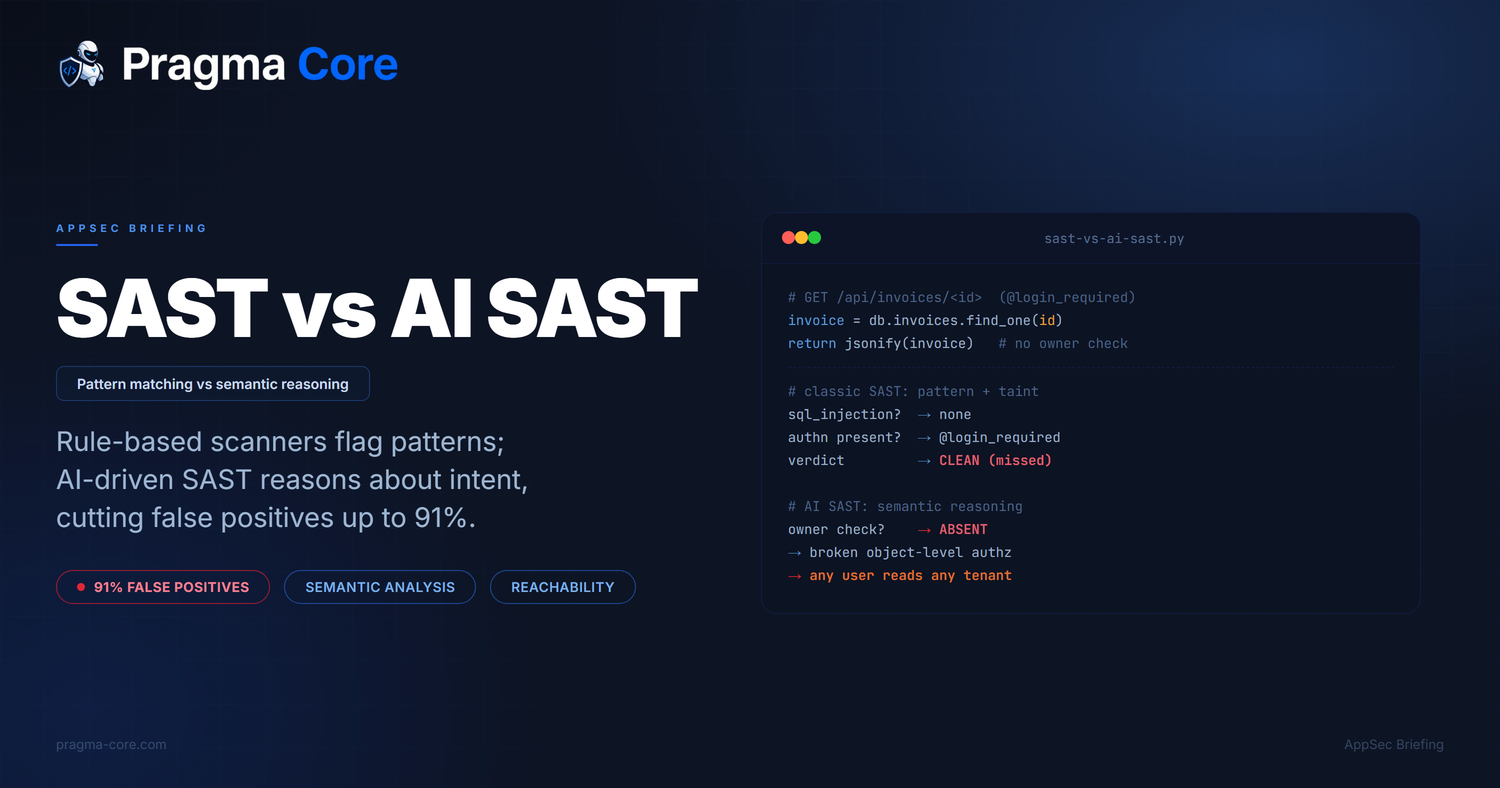
Run a classic SAST over this. The taint engine looks for invoice_id flowing into a dangerous sink. It does not. find_one against a document store is not on the SQL-injection rule. There is no shell call, no HTML sink, no banned API, no hardcoded secret. The @login_required decorator is even present, so a naive "is this endpoint authenticated" rule is satisfied. The verdict is CLEAN.
The verdict is wrong. This is a textbook broken-object-level-authorization bug, an IDOR: the handler confirms the caller is some logged-in user, then returns any invoice by id with no check that the invoice belongs to the caller. Change the id in the URL and you read another tenant's billing data. The vulnerability is not in any line. It is in a line that is absent: the ownership check that should sit between the lookup and the return.
This is the canonical failure mode of pattern-based analysis. You cannot write a taint rule for "the developer forgot to compare invoice.owner_id to current_user.id," because the bug is the lack of a comparison, and its dangerousness depends entirely on knowing that an invoice is a tenant-scoped resource. That requires a model of the application's intent, which the classic pipeline does not have.
The root cause: form versus meaning
The two failure directions of classic SAST both fall out of this same root.
False positives happen because the rulebase reasons locally. A rule fires when tainted data reaches a sink, but the rule does not know that three frames up the input was constrained to an integer, or that the "sink" is only ever called with a constant in this codebase, or that the framework auto-escapes the value. The tool flags a code path that is real in the abstract but impossible in context. Multiply by a large codebase and you get the 91% noise. Checkmarx, in independent 2024 Tolly testing, showed a false-positive rate above 36%; the broader public-repo numbers run far higher.
False negatives happen because the rulebase is finite and hand-maintained. Every novel framework, every custom sanitizer the tool does not recognize, every logic bug that is not expressible as a taint-to-sink shape, falls through. Maintaining a comprehensive, precise set of taint specifications for modern frameworks by hand is, in the words of recent research on the problem, exceedingly arduous and error-prone. When a new pattern emerges, the rulebase lags, and the lag is a window of missed bugs.
Both problems are the same problem wearing two coats: the analyzer manipulates the form of the code and never builds a model of its meaning.
Exploitation of the gap: how AI-powered SAST reasons instead
AI-powered SAST does not throw away the pipeline above. The good implementations keep the deterministic engine precisely because it is fast and high-recall, and they add a reasoning layer that does what the rulebase cannot. There are three moves that matter, and it is worth being concrete about each.
1. Semantic reachability instead of syntactic reachability. Classic taint analysis propagates a label along syntactic edges. A reasoning layer asks the harder question: under which concrete conditions does tainted data actually arrive at this sink, and is there a guard that makes it impossible? This is what lets a reasoning-augmented tool eliminate up to 98% of high-severity dependency false positives: it checks whether the vulnerable function in the dependency is even on a path your code can trigger, rather than flagging the package because it is present.
# the same finding, two verdicts

classic SAST (taint + rules)
  sql_injection?     -> no match
  xss_sink?          -> no match
  banned_api?        -> no match
  authn present?     -> @login_required found
  VERDICT            -> CLEAN          (false negative)

AI SAST (semantic reasoning)
  resource type?     -> invoice = tenant-scoped
  owner check on id? -> ABSENT
  reachable as user? -> yes, any session
  VERDICT            -> BROKEN OBJECT-LEVEL AUTHZ
                     -> any user reads any tenant's data
2. Intent and business-logic modeling. A reasoning layer can infer that invoice is owned by a tenant, that the route exposes it by id, and that the missing comparison is therefore a security boundary, not a style nit. This is the category, logic and authorization, where classic SAST scores close to zero and where most of today's serious application bugs actually live.
3. Triage, explanation, and grounded fixes. Even where the deterministic engine is right, the reasoning layer adds context: it ranks findings by exploitability, writes the data-flow path in prose a developer will read, and in mature tools proposes a fix that is checked against the surrounding code rather than pattern-pasted. Vendors report this is where the headline noise reductions come from. The crucial caveat: an LLM with no grounding in the actual repository will both hallucinate findings and miss real ones. The quality of an AI SAST is almost entirely a function of how tightly its reasoning is bound to the real call graph, framework, and data model, not the size of the model behind it.
Where AI-powered SAST itself goes wrong
Honesty about the new approach matters as much as criticism of the old one. Reasoning layers are non-deterministic: the same code can yield slightly different output across runs, which complicates regression gating. Without reachability grounding, an LLM "security review" is a confident guesser, and a confident guesser at scale is its own kind of noise. Latency and cost per finding are real, which is why nobody runs pure-LLM analysis on every keystroke; the deterministic engine still does the cheap, broad first pass. And the market is full of tools that bolt a chat box onto a legacy scanner and call it AI. The differentiator is not the presence of a model. It is whether the system traces real cross-file data flow and reasons about your application's intent, or whether it is a rulebase with better marketing.
The evolution of static analysis
| Era | Dominant technique | Core limitation it hit |
|---|---|---|
| 1970s to 1990s | Lint and style checkers on the AST | No data flow; only local syntactic issues |
| 1990s to 2000s | Taint and data-flow analysis, CFG | Local reasoning; rising false positives |
| 2000s to 2010s | Commercial rule-based SAST at scale | Rulebase maintenance burden; alert fatigue |
| 2010s to early 2020s | Lightweight, code-like rules (Semgrep era) | Still pattern matching; blind to logic and authz |
| 2024 onward | Engine plus LLM semantic reasoning and reachability | Non-determinism; grounding and cost; hype risk |
The arc is consistent: every generation pushed the boundary of how much context the analyzer could hold, from a single line, to a function, to a data-flow path, and now to the program's intent. AI-powered SAST is the next step on that same line, not a break from it.
A note on the discovery methodology
The methodological shift underneath all of this is worth stating plainly. Classic SAST is deductive within a fixed rulebase: it can only find what someone already described. The reasoning approach is closer to how a human auditor works, abductive: it forms a hypothesis about what the code is supposed to guarantee, then looks for places that guarantee is not enforced. Recent academic work, from LLM-driven constraint solving to vulnerability discovery agents, is formalizing exactly this move from "verify against known patterns" to "reason toward what could be wrong." The meta-lesson for the AppSec community is not that models are magic. It is that the bottleneck was never detecting known shapes. It was understanding meaning at the scale of a whole codebase, and that is finally tractable. The right posture is skeptical adoption: insist on grounding and reachability, measure precision on your own code, and keep humans pointed at the hardest questions.
What we should learn from the SAST shift
- A finding count is a vanity metric; a true-positive rate is the real one. A tool that produces 2,000 findings at 9% precision is worse than one that produces 200 at 90%, because the first one trains your developers to ignore it. Measure precision, not volume, and judge every tool against the precision baseline of your own repositories.
- The dangerous bugs are increasingly absences, and you cannot grep for an absence. Missing authorization checks, missing tenant scoping, missing re-authentication on a sensitive action: these define modern application risk and they are invisible to pattern matching by construction. Any analysis that cannot reason about what should be present will keep missing them.
- Reachability is the line between signal and noise. "This pattern exists" is nearly worthless; "tainted input can reach this sink under these conditions and it matters" is actionable. Demand reachability from any tool, classic or AI, before you trust its severity.
- AI-generated code is the new hotspot for logic bugs. Assistant-written code is typically clean of syntactic flaws and naive about intent, the exact profile that slips past rule-based SAST and gets caught by semantic analysis. The volume of such code is rising fast, and your detection strategy has to assume it.
- "AI" is a capability claim to be verified, not a feature to be bought. The useful question is never "is there a model in here." It is "does it trace cross-file data flow and reason about my application's intent, and can it prove a finding's path." Make every vendor demonstrate that on your code, not a demo repo.
How Pragma Core addresses this class of problem
Pragma Core is built for exactly the gap this article describes: the bugs that are not a single bad line but a property of how input and state move across functions, services, and trust boundaries, the class that rule-based scanners structurally miss. It is an AI-driven application security platform from zer0day Technologies and Expertware that connects to a team's repositories and runs continuous scanning, research, and pentesting. The point of the sections below is not that it has "AI." It is how the reasoning is grounded, which is the only thing that separates a real AI SAST from a rebrand.
SAST tuned for the relevant pattern, not just injection sinks
Off-the-shelf SAST is tuned for taint flows that end in a SQL or shell sink, which is why the get_invoice IDOR earlier reads as CLEAN to it. Pragma Core's static analysis is built to reason about the pattern that actually matters in modern code: a resource exposed by id with the ownership check absent, a security gate present on one path and missing on another, a sanitizer the framework applies that a rule does not recognize. The missing-authorization case is a high-confidence finding, not a blind spot, precisely because the analysis models intent rather than matching shapes.
Autonomous AI agents for attack chain investigation
The platform's autonomous agents reason over chains rather than stopping at a flagged line. For the invoice handler, the agent asks the questions a human auditor would: what kind of resource is this, who is allowed to read it, is the check that enforces that enforced on every path, and can a low-privilege session reach it. That is the abductive style described above, "what is this code supposed to guarantee, and where is the guarantee not enforced," applied systematically to the whole repository instead of one function at a time.
Interactive call graphs with vulnerability overlay
Because the dangerous bugs live in relationships between functions, Pragma Core auto-generates call graphs for every connected repo and overlays findings onto them. For a cross-path authorization mismatch, the value of this is direct: you can see the handler that has the ownership check and the handler that does not, side by side, and watch where a tenant identifier stops being honored. The flaw was never in one node; it was in the edge between two, and the call graph is where an edge-shaped bug becomes visible.
Reachability-aware triage to kill the false-positive flood
The 91% noise problem is the one Pragma Core's reasoning layer is designed to attack. Rather than reporting every pattern match, it asks whether tainted input can actually reach the sink under real conditions and whether the result is exploitable, the same reachability logic that lets modern engines drop up to 98% of high-severity dependency false positives. The output a team sees is a short list of findings they can trust, which is the only state in which a scanner gets read instead of ignored.
Human-guided AppSec investigations
For the questions that are too subtle even for an agent to close on its own, the expert-led research module lets an AppSec operator drive deeper analysis, backed by the autonomous agents and the full platform context already in the workspace. This is exactly the move recommended in Part I, keeping a human in the loop for the bugs that matter, made into a workflow rather than a separate black-box engagement. The team spends its scarce expert time on what is genuinely fragile, not on adjudicating nine hundred false positives.
Continuous, native repository integration
Pragma Core connects to GitHub, GitLab, and Azure DevOps in minutes, and continuous scanning starts immediately, with every finding contextualized by repository, branch, and commit. That continuity matters specifically for the AI-generated-code hotspot: the logic-and-authorization bugs that assistants introduce show up the moment they land, on the path where they were merged, rather than in a quarterly scan nobody reads.
Closing thoughts
The SAST shift is not, fundamentally, a story about adding machine learning to a scanner. It is a story about the kind of bug that defines modern risk changing underneath a technique that could not follow. Classic SAST was built when vulnerabilities were local properties of code, shapes you could describe and search for. Today's serious bugs are relational and intentional: a check that is missing, a boundary that two services disagree about, an assumption that holds on the write path and breaks on the read path. You cannot pattern-match your way to those, because they are defined by meaning and absence, not by form.
The same patterns live in nearly every modern architecture, multi-tenant SaaS, cloud control planes, internal platforms, and the rising tide of AI-generated code. The difference between treating this article as an interesting trend and using it as an audit trigger comes down to two things: how mature your AppSec process is, and how much real visibility you have into your own code. Organizations that want to move from "we scan and report" to "we systematically investigate what is fragile" can reach Pragma Core at pragma-core.com for a demo.
Sources
- Pixee, SAST False Positives: 91% Are Noise. Here's the Fix, 2025.
- Apiiro, Introducing Apiiro AI-SAST: Static Scanning Reimagined, From Code to Runtime, 2025.
- Semgrep, App Security Platform: AI-assisted SAST, SCA and Secrets Detection, semgrep.dev, 2025.
- ZeroPath, Static Code Analysis: The Complete Guide, 2026.
- Augment Code, AI SAST: The 2026 Guide to AI-Powered Static Application Security Testing, 2026.
- InfoWorld, How pairing SAST with AI dramatically reduces false positives in code security, 2025.
- Mobb, Top SAST Tools Compared by False Positive Rate, 2025.
- arXiv, VULSOLVER: Vulnerability Detection via LLM-Driven Constraint Solving, 2509.00882.