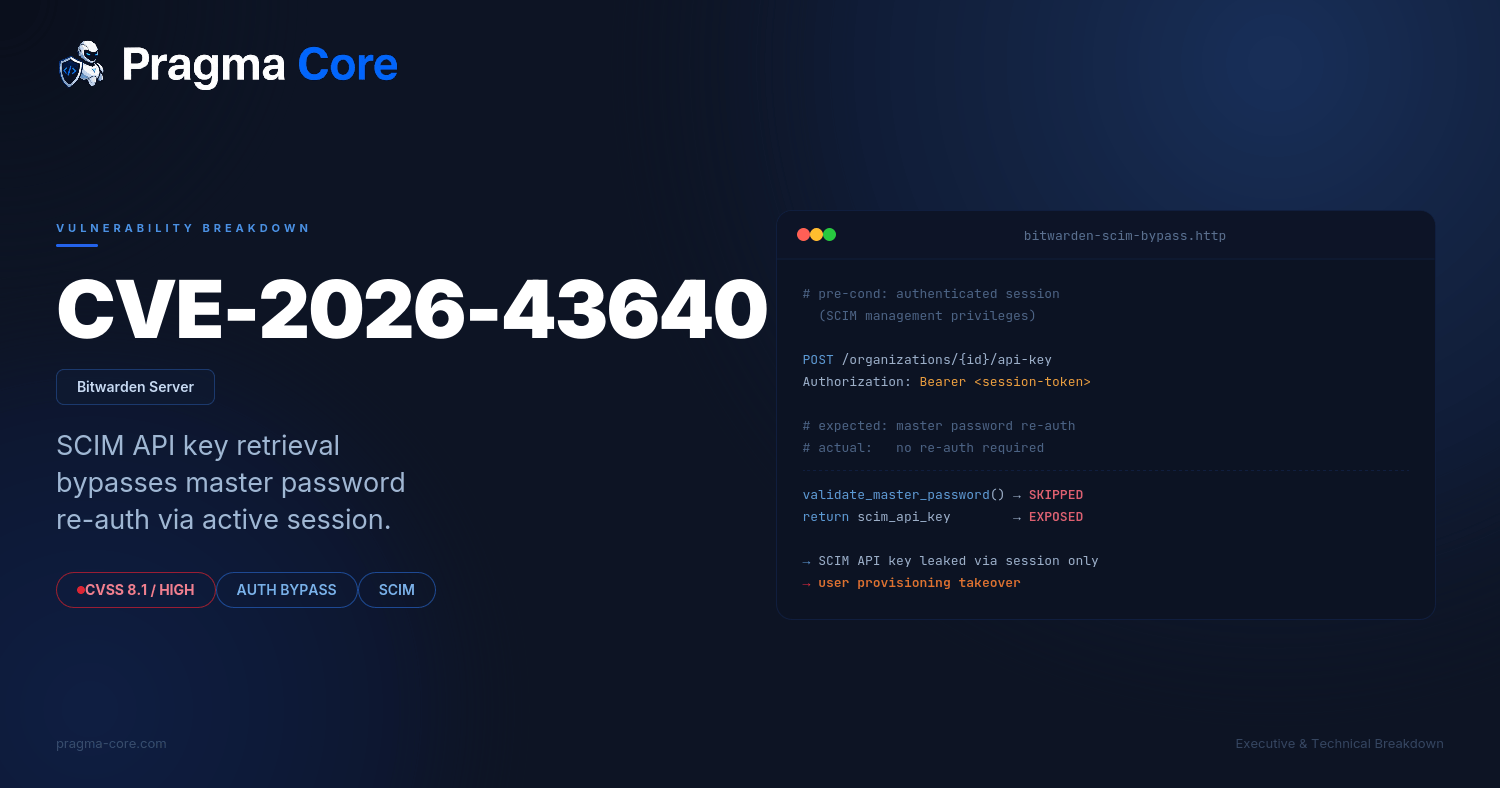
On May 8, 2026, offensive security researcher Sanjok Karki published a writeup of a vulnerability he had reported to Bitwarden through HackerOne almost six weeks earlier. The verdict was uncomfortable: a single misplaced boolean operator in the Bitwarden server's organization API key controller allowed any authenticated user holding a stolen session, with SCIM management privileges, to retrieve or rotate the organization's SCIM API key, without ever re-entering the master password. The vulnerability was assigned CVE-2026-43640 with a CVSS score of 8.1.
This article is a two-layered breakdown. The first part is written for non-technical readers who need to decide quickly whether they have anything to do and what exactly. The second part dissects the code path the way the researcher reconstructed it, plus a discussion of what this class of bug means for any application that wraps high-value secrets behind a "re-auth with master password" gate. At the end, we look at how the Pragma Core platform addresses exactly the kind of problems that made this breach possible.
Part I. Executive breakdown
What happened
Bitwarden Server, the backend that powers self-hosted Bitwarden deployments and Bitwarden Cloud, exposes two endpoints on the organizations API that return or rotate organization API keys: POST /organizations/{id}/api-key and POST /organizations/{id}/rotate-api-key. These endpoints are gated by a re-authentication step: the user has to submit the master password again, even if they have a valid session, before the server hands out the key. This is the same defense in depth pattern used by many password managers and identity platforms to ensure that a stolen session token alone is not enough to extract long-lived credentials.
The defense was implemented as a single boolean expression:
if (model.Type != OrganizationApiKeyType.Scim
    && !await _userService.VerifySecretAsync(user, model.Secret))
C# evaluates && from left to right and short-circuits. When the requested key type is Scim, the left side of the expression is false, so the right side, the call to VerifySecretAsync, is never executed. The code falls through to the else branch, which simply returns the SCIM API key. Any non-empty value in the request body is enough to satisfy the model validator. A stolen session token plus a one-character placeholder string is the entire exploit.
What you get out of this is the organization's SCIM API key. SCIM (System for Cross-domain Identity Management) is the integration channel used to provision and deprovision users from an identity provider into Bitwarden. The key is long-lived, lives outside the regular session model, and continues to work after the original user changes their password, revokes their session, or rolls their MFA. Stealing it gives an attacker the ability to create, modify, and delete users in the organization at will, for as long as the key is not rotated.
Who is affected
| Component | Status |
|---|---|
| Bitwarden Cloud (all tenants) | Fixed by Bitwarden on 2026-05-05/06. No user action required. |
Bitwarden self-hosted Server < v2026.4.1 |
Vulnerable. Upgrade required. |
Bitwarden self-hosted Server >= v2026.4.1 |
Patched (release dated 2026-04-20). |
| Bitwarden client apps | Not directly affected. The bug is server-side. Updated clients align with the server-side change so the SCIM management UI now prompts for the master password. |
The exploit requires a valid Bitwarden session with Admin role, or a Custom role with ManageScim permission on the target organization. That sounds restrictive on paper. In practice, this is precisely the population that gets phished, has their browser exploited, or runs malicious extensions, because it includes the people who administer the password manager itself. Once an attacker has any of these sessions, the SCIM key is a single POST away.
Importantly, this scope only matters on Enterprise and Teams plans, where SCIM provisioning is available. Free and personal plans are not affected.
Why this matters beyond Bitwarden
The bug itself is one of the most common shapes in modern application security work: a security check guarded by another condition, where the guard is attacker-influenced. The pattern is everywhere. It hides in OAuth scope checks, in admin-vs-user branching, in feature flags, in step-up authentication, and in every "early return for a special case" piece of glue code. The reason it survives code review is that the English reading of if (X != Special && verify()) is "verify, with a special case for X". The code reading is "for the special case of X, skip the verify entirely". One is a feature, the other is a vulnerability, and they look identical until you actually trace what happens for each value of X.
The other lesson is about UX shortcuts on the wrong side of the trust boundary. The Bitwarden web client passes the literal string "N/A" as the master password hash when calling these endpoints with a SCIM key type. The triager explicitly confirmed this was an intentional UX choice: the SCIM settings page was designed to allow viewing or rotating the SCIM key without an extra password prompt. That choice was then enforced on the server by exempting the SCIM type from re-authentication. The server should never trust a client-supplied "skip the password check" signal, regardless of how it is encoded.
Recommended actions
- Upgrade self-hosted Bitwarden Server to
v2026.4.1or later immediately. The release dated April 20, 2026 contains the one-line fix in both the retrieval and rotation endpoints. No configuration change is required. - Rotate every SCIM API key in your Bitwarden organizations after upgrading. If your self-hosted instance was online and reachable by anyone with an Admin or
ManageScimsession between 2026-03-25 (the date of the original report) and the date you patched, treat the existing key as potentially compromised. The same applies to Cloud tenants where Admin sessions could plausibly have been stolen during the window between report and Cloud fix. - Audit your SCIM event logs for unexpected user provisioning or deprovisioning during the exposure window. SCIM activity is logged separately from interactive user activity in most identity providers, and that is where the attacker would have left traces.
- Inventory who holds the SCIM management role. Admin and Custom +
ManageScimare the only roles that can hit the vulnerable endpoint. Reduce that set to the absolute minimum. - Treat this as a session theft drill. If any of your Bitwarden Admins is a high-value target (CISO, IT, security team), assume their sessions could be the next attack surface for a similar issue. Enforce hardware-backed MFA, short session lifetimes, and aggressive session revocation on master password change.
Part II. Technical breakdown
The endpoints and their intended contract
Two endpoints on the Bitwarden organizations API are involved:
POST /organizations/{id}/api-keyretrieves an existing organization API key of a given type, creating it on the fly if it does not exist yet.POST /organizations/{id}/rotate-api-keyinvalidates the current key of a given type and issues a new one.
Both accept the same request body shape:
{
    "type": 2,
    "masterPasswordHash": "..."
}
The type field is an enum (OrganizationApiKeyType) that selects which API key the request is about. The three relevant values are:
| Value | Name | Caller role required | Purpose |
|---|---|---|---|
| 0 | Default | Owner | General organization API key |
| 1 | BillingSync | Owner | Billing synchronization with the Bitwarden Self-Hosted licensing service |
| 2 | Scim | Admin (or Custom + ManageScim) |
SCIM provisioning endpoint authentication |
The intended security contract is straightforward: regardless of the key type, the caller must prove possession of the master password by including a fresh MasterPasswordHash (or one of the equivalent alternatives, OTP or AuthRequestAccessCode). The server verifies that secret via VerifySecretAsync, and only if the verification succeeds does it return or rotate the key.
This contract holds for type=0 and type=1. It does not hold for type=2.
The vulnerable code
The retrieval endpoint, as it existed before the patch, in src/Api/AdminConsole/Controllers/OrganizationsController.cs:
[HttpPost("{id}/api-key")]
public async Task<ApiKeyResponseModel> ApiKey(string id, [FromBody] OrganizationApiKeyRequestModel model)
{
    var orgIdGuid = new Guid(id);
    if (!await HasApiKeyAccessAsync(orgIdGuid, model.Type))
        throw new NotFoundException();

    var organization = await _organizationRepository.GetByIdAsync(orgIdGuid);
    if (organization == null) throw new NotFoundException();

    if (model.Type == OrganizationApiKeyType.BillingSync ||
        model.Type == OrganizationApiKeyType.Scim)
    {
        var productTier = organization.PlanType.GetProductTier();
        if (productTier is not ProductTierType.Enterprise and not ProductTierType.Teams)
            throw new NotFoundException();
    }

    var organizationApiKey =
        await _getOrganizationApiKeyQuery.GetOrganizationApiKeyAsync(organization.Id, model.Type)
        ?? await _createOrganizationApiKeyCommand.CreateAsync(organization.Id, model.Type);

    var user = await _userService.GetUserByPrincipalAsync(User);
    if (user == null) throw new UnauthorizedAccessException();

    // The bug.
    if (model.Type != OrganizationApiKeyType.Scim
        && !await _userService.VerifySecretAsync(user, model.Secret))
    {
        await Task.Delay(2000);
        throw new BadRequestException("MasterPasswordHash", "Invalid password.");
    }
    else
    {
        // Reached without password verification when Type == Scim.
        return new ApiKeyResponseModel(organizationApiKey);
    }
}
The rotation endpoint at POST /{id}/rotate-api-key had the same conditional, with RotateApiKeyAsync placed in the else block instead of the response build.
Two things matter about this code:
- The condition
model.Type != OrganizationApiKeyType.Scim && !await _userService.VerifySecretAsync(...)is evaluated as a single boolean expression. C#'s&&is short-circuiting. Whenmodel.Type == OrganizationApiKeyType.Scim, the left operand evaluates tofalse, and the right operand is never executed.VerifySecretAsyncis the master-password verification routine. It does not run. - The flow of control proceeds into the
elsebranch, which simply returns the API key. There is no separate check, no second gate, no audit log entry that would record "SCIM key extracted without password proof".
The intent the original author seems to have had was: "for SCIM, treat the password verification as optional". The way it ended up encoded was: "for SCIM, skip the password verification entirely". Those two readings produce identical code, and only the second matches what the runtime does.
What model validation actually validates
The request model, OrganizationApiKeyRequestModel, extends SecretVerificationRequestModel:
public class SecretVerificationRequestModel : IValidatableObject
{
    public string MasterPasswordHash { get; set; }
    public string OTP { get; set; }
    public string AuthRequestAccessCode { get; set; }

    public string Secret => !string.IsNullOrEmpty(MasterPasswordHash)
        ? MasterPasswordHash : OTP;

    public virtual IEnumerable<ValidationResult> Validate(...)
    {
        if (string.IsNullOrEmpty(Secret) && string.IsNullOrEmpty(AuthRequestAccessCode))
            yield return new ValidationResult("MasterPasswordHash, OTP, or AccessCode must be supplied.");
    }
}
The model validation insists that the request contains some secret value (in either MasterPasswordHash, OTP, or AuthRequestAccessCode). It does not check that the value is correct, valid, or even shaped like a real hash. That is VerifySecretAsync's job, and VerifySecretAsync is precisely what the short circuit skips.
The practical consequence: an attacker only needs to put any non-empty string in masterPasswordHash for the model layer to accept the request. The string "x" works. The string "N/A" (which is what the Bitwarden web client actually sends) works. The string "" is the only one that fails, and that fails at the model layer, not the auth layer.
Why the bypass exists at all
The historical context, confirmed by the Bitwarden triager on the HackerOne report, is that the SCIM settings page in the web client was designed to allow Admins to view and rotate the SCIM key without an additional password prompt. The web client encoded this by passing the literal string "N/A" as the master password hash. The server side honored that intent by exempting SCIM key types from VerifySecretAsync.
The asymmetry that turned this into a vulnerability is in the role and persistence model:
| Key type | Re-auth required (pre-fix) | Caller role required | Persistence outside session |
|---|---|---|---|
| Default (0) | Master password | Owner | Yes |
| BillingSync (1) | Master password | Owner | Yes |
| Scim (2) | None | Admin or Custom + ManageScim |
Yes, survives password change |
SCIM has both the lowest re-authentication bar (none, by design) and the lowest role requirement (Admin or a Custom role flag, rather than Owner). It also produces the most persistent, out-of-band credential. A SCIM key keeps working as long as it has not been rotated, regardless of the user changing their master password, rolling MFA, or revoking the session that obtained it.
In other words: of all the organization API key types in this controller, SCIM is exactly the one that an attacker would most like to extract with a stolen session, and the only one that did not require master-password proof.
Differential confirmation on Cloud
Source review tells you what to expect. The server has to confirm it. The researcher relied on a differential between two requests against the live Bitwarden Cloud:
Test 1: type=0 (Default), MasterPasswordHash="wrong"
  HTTP 400
  Body: {"validationErrors": {"MasterPasswordHash": ["Invalid password."]}}
  Conclusion: VerifySecretAsync was called, rejected the wrong hash.

Test 2: type=2 (Scim), MasterPasswordHash="wrong"
  HTTP 500 (server error)
  Conclusion: VerifySecretAsync was NOT reached. The handler walked past
  the auth gate and tripped on a downstream call (no SCIM key record
  exists on a free-plan test org).
A 500 response is generally not what a researcher wants, but in this case it is the strongest possible confirmation: the only way to reach the code path that crashes is to have skipped the password check. On an Enterprise or Teams organization with SCIM enabled, the same request would have returned HTTP 200 with the live SCIM key in the body. The control flow is identical, just with a row to read at the end. The destructive test was not run against a real Enterprise tenant, because the differential was already conclusive.
Attack flow
The complete exploitation chain, end to end:
- Compromise a session. The attacker obtains a Bitwarden session token belonging to a user with
ManageScimpermission. This includes any Admin and any Custom role with the SCIM management flag. The vector is anything that yields a session: XSS in adjacent web property, malicious browser extension, cookie theft, leftover token in a recovered laptop, OAuth phishing of a federated identity, or a compromised SSO provider. - Retrieve the SCIM key without the password. The attacker sends:
POST /api/organizations/{ORG_ID}/api-key
Authorization: Bearer <stolen session token>
Content-Type: application/json

{ "type": 2, "masterPasswordHash": "x" }
The server returns HTTP 200 and the SCIM API key in the response body.
3. Optionally lock the legitimate SCIM integration out. The attacker sends the same request to /rotate-api-key instead of /api-key. The old SCIM key is invalidated, and only the attacker holds the new one. The legitimate identity provider integration breaks until an administrator notices and re-rotates.
4. Use the SCIM key directly. The key authenticates against the SCIM endpoints, which are separate from the session-based API. The attacker can now create users, delete users, and modify group membership in the organization. The key is not bound to the original session, so it survives password changes, MFA re-enrollment, and session revocation. It only stops working when explicitly rotated.
The interesting property is persistence. Master-password re-authentication on key retrieval exists precisely so that "attacker holds a session" does not equal "attacker holds a long-lived organization credential". The short circuit collapsed those two states for SCIM keys.
The fix
The patch is one of the cleanest you will see. PR #7403, commit eb251d9b, applied the same diff to both the retrieval and rotation endpoints:
- if (model.Type != OrganizationApiKeyType.Scim
-     && !await _userService.VerifySecretAsync(user, model.Secret))
+ if (!await _userService.VerifySecretAsync(user, model.Secret))
  {
      await Task.Delay(2000);
      throw new BadRequestException("MasterPasswordHash", "Invalid password.");
  }
- else
- {
-     var response = new ApiKeyResponseModel(organizationApiKey);
-     return response;
- }
+
+ var response = new ApiKeyResponseModel(organizationApiKey);
+ return response;
Two type-based exemptions removed, the dead else collapsed, and tests added in the same PR. The web client was updated in parallel so that the SCIM management page now prompts for the master password the same way the other key types already did. The "N/A" placeholder was deleted from the client.
Timeline
| Date | Event |
|---|---|
| 2026-03-25 | Report submitted to HackerOne (#3627893). |
| 2026-03-27 | Severity adjusted, report triaged. Bitwarden confirms the bypass was intentional in the original design but agrees the design is wrong. |
| 2026-04-08 | Patch lands on main: PR #7403, commit eb251d9b. |
| 2026-04-20 | Self-hosted release v2026.4.1 ships with the fix. |
| 2026-05-05 to 06 | Bitwarden Cloud deploys the remediation. Report resolved with bounty. |
| 2026-05-08 | Public writeup published by the researcher. |
| 2026-05-11 | CVE-2026-43640 published in the NVD with CVSS 8.1. |
A note on the discovery methodology
CVE-2026-43640 was found by manual source code review of the open-source Bitwarden Server, by an offensive security researcher who routinely audits high-value identity and secrets management products. The bug did not require fuzzing, did not require a working exploit infrastructure, and did not require reverse engineering of compiled binaries. It required reading the controller carefully, noticing the short circuit, and asking "what happens for each value of the type field?".
This is worth calling out because it sits at the opposite end of the discovery spectrum from the AI-assisted reverse engineering work that has produced recent headline CVEs in NGINX, GitHub, and other closed-source systems. Auth-bypass bugs in open-source backends remain the cheapest, highest-yield target an experienced reviewer can pick up on a quiet afternoon. The hard part is reading the code with the right hypothesis in mind. Tools can help, but the cognitive frame ("which user-controlled value, in which expression, can short circuit a security check?") is what produces the finding.
What we should learn from CVE-2026-43640
A few patterns show up repeatedly in this kind of bug, and they are worth investigating proactively in any codebase:
- Security guards are expressions, not English sentences.
if (X != Special && verify())does not mean "verify, with a special case for X". It means "for the special case of X, skip the verify entirely". IfXis influenced by attacker input, that is a bypass. Every security guard that combines an early-exit condition with a verification call should be flagged for review. - A server-side "skip the password check" shortcut is not a UX choice. It is a re-authentication removal. If the client wants to avoid prompting the user, the right primitive is a short-lived, server-issued, elevated-session token that proves the user authenticated recently, not a magic string the server is told to ignore.
- High-impact key types deserve more re-authentication, not less. The asymmetry in this case is the worst possible: the key with the longest persistence, the broadest provisioning power, and the most relaxed role requirement was also the one that had no re-auth. When you classify your sensitive operations by impact, the most powerful ones should sit behind the strongest gate, not the weakest.
- Differential testing beats "I cannot run the full PoC". When the destructive path requires conditions you cannot reproduce (a paid tier, a specific tenant configuration, a particular feature flag), find the cheapest server-observable difference between "check ran" and "check skipped". Here, an HTTP 400 versus an HTTP 500 was enough. Look for behavioral footprints, not just exploit primitives.
- The smallest patches sometimes guard the largest blast radii. The fix for this CVE is one line removed per endpoint. The damage it could have caused is full SCIM-level user provisioning persistence across every Bitwarden Enterprise and Teams organization. Patch surface and impact surface are entirely uncorrelated.
How Pragma Core addresses this class of problem
Pragma Core is an application security platform built specifically for the class of issues that made CVE-2026-43640 possible. We are talking about vulnerabilities that classical scanners often miss, because they are not about a known-bad function call. They are about how authorization checks are composed, where the trust boundary sits, and what implicit assumptions get encoded into a single boolean expression.
Here are the concrete connections between what the platform does and the bug class this CVE represents:
Autonomous AI agents for attack chain investigation
The autonomous agents in Pragma Core do not stop at "this endpoint calls a verifier". Their reasoning over attack chains tries to answer questions like: "Under which combinations of user-controlled inputs is the verifier actually invoked? Are there short-circuit operators in the condition that could skip it? What role boundary protects this code path, and is that boundary lower-privileged than the credential being returned?". That is exactly the kind of reasoning that surfaces a != Special && verify() bypass before an attacker does.
Interactive call graphs with vulnerability overlay
The vulnerable code in this CVE sits at the intersection of a controller action, a request model, and a user service. The bug is not in any one of these in isolation; it is in the relationship between them. Pragma Core generates call graphs automatically for any connected repository, visualizing how classes, functions, and calls connect across the codebase. Overlaying identified vulnerabilities on top of these graphs lets teams see which controllers reach which authentication services, under which conditions, and where those conditions can be influenced by request data.
SAST tuned for authorization patterns, not just injection sinks
Most off-the-shelf SAST tools are tuned for taint flow ending in a SQL or shell sink. They produce thousands of low-signal findings on injection patterns and miss authorization composition bugs entirely. Pragma Core's static analysis is tuned to flag patterns specific to authorization and re-authentication: short-circuit operators around verification calls, type or enum-based exemptions on security gates, and asymmetric checks across endpoint families. A pattern like the Bitwarden one would have been a high-confidence finding rather than a lucky catch.
Continuous tracking of third-party packages
Many organizations run Bitwarden Server inside their own environments as a critical part of their identity infrastructure. Self-hosted password managers are exactly the kind of dependency that does not show up in classic package inventories because they are deployed as containerized services or appliances. Pragma Core tracks every third-party package and service across all connected repositories, surfacing vulnerable versions with CVSS scores and fixed upgrade paths. For a CVE like this one, the practical effect is that an organization running self-hosted Bitwarden gets notified the moment the CVE lands in the catalog, with a direct upgrade target.
Human-guided AppSec investigations
The expert-led research module in Pragma Core is built precisely for the type of investigation Sanjok Karki did here: take a real, production controller in a security-critical product, read it with adversarial intent, and ask the questions a code-review checklist will not ask for you. An AppSec operator drives that analysis, supported by autonomous agents, automated scans, and the platform context already available in the workspace. The focus is on what your team feels is fragile: authentication flows, secret retrieval endpoints, privilege escalation surfaces. Not a separate black-box engagement, but a natural extension of your existing subscription, leveraging your existing repository coverage and findings.
Native repository integration
The platform connects to GitHub, GitLab, and Azure DevOps in minutes. For an organization that maintains its own fork of Bitwarden, or that builds similar identity tooling in-house, integration is direct: continuous scanning starts immediately, and the findings generated are contextualized with repository, branch, and commit.
Closing thoughts
CVE-2026-43640 is not, fundamentally, a bug about Bitwarden or about SCIM. It is a bug about what happens when a security guard is written as a single boolean expression where one operand is attacker-influenced, and when a UX convenience on the client side gets enforced as a security exemption on the server side. The same shape of bug exists in countless other identity, secrets, and admin endpoints across the modern stack. Most of them have not been found yet.
The difference between an organization that reads this article as a curiosity and one that uses it as a trigger for an audit usually comes down to how mature the application security function is and how much visibility teams have into their own code. For organizations that want to move from "we scan and report" to "we systematically investigate what is fragile", Pragma Core was built to make that step. You can reach us directly at pragma-core.com for a demo or to talk about how the platform could fit into your security pipeline.
Sources
- Sanjok Karki, Bitwarden: SCIM API Key Retrieval Skips Master-Password Re-Auth via && Short-Circuit, May 8, 2026.
- HackerOne Report #3627893, Bitwarden Server SCIM API Key Re-Authentication Bypass, disclosed 2026-05-06.
- bitwarden/server, Pull Request #7403, Require master password verification for SCIM API key retrieval and rotation, merged 2026-04-08.
- bitwarden/server, Release
v2026.4.1, 2026-04-20. - NVD, CVE-2026-43640 Detail, published 2026-05-11.
- RedPacket Security, CVE Alert: CVE-2026-43640: bitwarden server, 2026-05-11.
- OffSeq Threat Radar, CVE-2026-43640: Incorrect Implementation of Authentication Algorithm in bitwarden server, 2026-05-11.