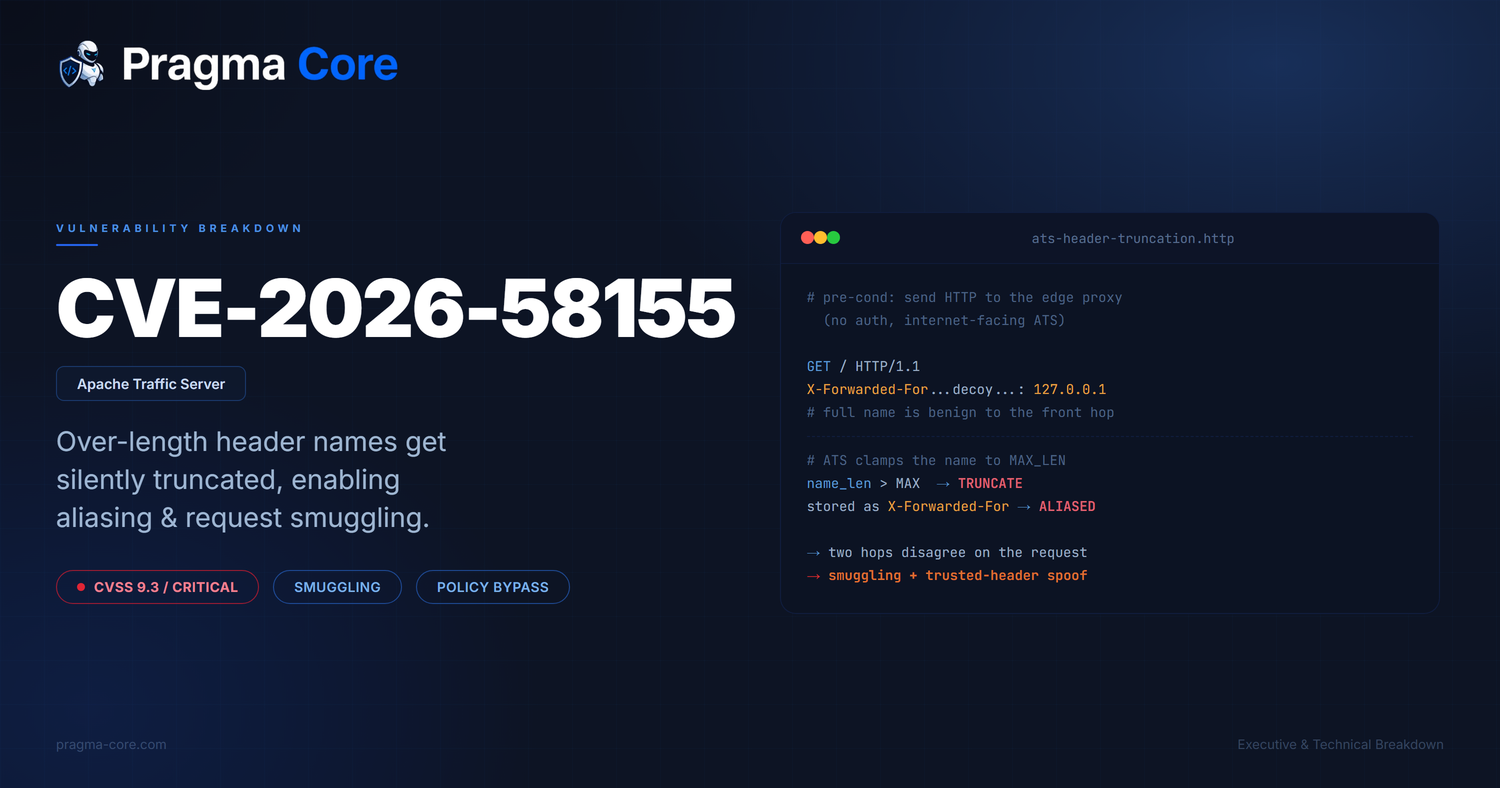
On July 29, 2026, the Apache Software Foundation published an advisory for its Traffic Server proxy that reads like a textbook lesson in parser disagreement. Traffic Server, one of the most widely deployed reverse proxies and caching layers on the internet, did not reject HTTP requests that carried absurdly long header field names. It quietly cut them down to a fixed size and kept going. An unauthenticated remote attacker can exploit that behavior to make the proxy and the servers behind it disagree about what a request actually contains, which opens the door to header aliasing, HTTP request smuggling, and access-policy bypass. The bug is tracked as CVE-2026-58155 and carries a CVSS 9.3 (critical) score under v3.1, and 9.2 under v4.0. The striking part is not the severity. It is that the entire attack rides on a length limit that was supposed to make the parser safer.
This article is a two-layered breakdown. The first part is for readers who need to decide quickly whether they have anything to do about this and what exactly that is: is my edge affected, what is the blast radius, what do I change today. The second part dissects the flaw the way an attacker or a reviewer would reconstruct it: where the truncation happens, why a truncated name is worse than a rejected one, and how that single behavior becomes smuggling and policy bypass across a two-hop proxy chain. The article closes by looking at how the Pragma Core platform addresses exactly the kind of problem that made this possible: a bug that lives in the disagreement between two parsers, not in any single bad line.
Part I. Executive breakdown
What happened
Apache Traffic Server (ATS) is a reverse proxy and cache that sits at the front of a lot of infrastructure, terminating client connections, applying routing and security policy, and forwarding requests to origin servers. Like every HTTP parser, it puts limits on how large parts of a request can be so that a hostile client cannot exhaust memory. One of those limits applies to the length of a header field name, the part before the colon in a line like X-Forwarded-For: 10.0.0.9.
The problem is what ATS did when a name went over that limit. Instead of refusing the request as malformed, it trimmed the name down to the maximum allowed length and processed the request as if the shortened name were the real one. Think of a mailroom that has space for only fifteen characters on an address label. A letter arrives addressed to a very long department name. Rather than returning it as undeliverable, the clerk snips the label at fifteen characters and delivers it to whatever department that shortened string happens to match. Two very different envelopes can end up in the same inbox, and a letter meant for nobody in particular can land on the desk of someone important.
The concrete result is that ATS can be made to see a header that the client never intended, or to see a security-relevant header where a front-end device saw only harmless gibberish. When ATS forwards the request to an origin, the two systems no longer agree on where one request ends and the next begins, or on which headers are present. That disagreement is the raw material for request smuggling and for slipping past routing and access controls that were keyed on header names.
Who is affected
| Component | Status |
|---|---|
| Apache Traffic Server 10.0.0 to 10.1.3 | Vulnerable. Upgrade to 10.1.4. |
| Apache Traffic Server 9.0.0 to 9.2.14 | Vulnerable. Upgrade to 9.2.15. |
| Apache Traffic Server 8.0.0 to 8.1.9 | Vulnerable and end of life. No fix will ship. Migrate to a supported 9.2.x or 10.1.x line. |
| Apache Traffic Server 9.2.15, 10.1.4 and later | Patched. |
Traffic Server is not a niche product. It powers commercial CDNs, large media delivery networks, and countless in-house edge tiers because it is fast, scriptable, and free. Most operators who run it have it terminating untrusted internet traffic by definition, which is precisely the position from which this bug is reachable. There is no authentication precondition and no unusual configuration required: the vulnerable behavior is in the core HTTP header parser on the default path. If you run an affected version at your edge, assume it is reachable from the internet by anyone who can send it a request.
Why this matters beyond Traffic Server
Request smuggling is not a Traffic Server disease. It is a structural hazard of any architecture where two or more HTTP implementations parse the same bytes in sequence: a load balancer in front of a proxy, a proxy in front of an application server, a CDN in front of an origin. The class is catalogued as CWE-444, "Inconsistent Interpretation of HTTP Requests." Every few years a new instance surfaces because someone finds one more field where two parsers can be coaxed into disagreeing: Content-Length versus Transfer-Encoding, trailing whitespace, obsolete line folding, and now the maximum length of a header name.
The lesson that generalizes is this: a length limit is a security control only if crossing it is a hard failure. The moment a parser responds to an over-limit input by silently repairing it into something shorter and still valid, the limit stops protecting you and starts manufacturing ambiguity. Any team running layered HTTP infrastructure should treat "what does each hop do with malformed or oversized headers" as a first-class question, not an implementation footnote.
Recommended actions
- Upgrade now. Move to Apache Traffic Server 9.2.15 or 10.1.4 (or later on each line). These releases reject over-length header names instead of truncating them.
- Get off the 8.x line entirely. The 8.x branch is end of life and will not receive a patch. If you are still on 8.0.0 to 8.1.9, plan a migration to a supported branch rather than waiting for a fix that is not coming.
- Inventory every ATS instance and its version. Include appliances, container images, and CDN edge nodes where ATS may be embedded and easy to forget. You cannot patch what you have not enumerated.
- Assume smuggling until patched and review upstream trust. Any access-control or routing decision your stack makes based on request headers (for example trusting
X-Forwarded-Foror an internal auth header from the edge) should be re-examined; a smuggled or aliased header can subvert it. - Hunt in your logs. Look for requests with unusually long header names, duplicate or aliased headers arriving at the origin, and response-queue anomalies (a client receiving a response that seems to belong to another request). These are the fingerprints of smuggling attempts.
- Tighten the request pipeline. Where feasible, put a strict HTTP validator that rejects oversized headers ahead of ATS, and ensure origins do not implicitly trust headers that a compromised edge could forge.
Part II. Technical breakdown
Background: header names, length limits, and the two-parser problem
An HTTP request is a start line followed by a sequence of header fields, each a name, a colon, and a value, terminated by CRLF, with a blank line marking the end of the header block. A proxy like Traffic Server reads this block into internal structures: it parses each field name, canonicalizes it, and stores it in a header collection (a HdrHeap and its MIMEHdr field table, in ATS terms) that the rest of the pipeline queries by name. Routing rules, cache keys, plugin logic, and forwarding decisions all read from that parsed representation, not from the raw bytes.
To keep a hostile client from sending a header name that is megabytes long and exhausting memory, ATS enforces a maximum field-name length during parsing. That limit is sensible. The question that decides whether it is safe is: what happens at the boundary. There are only two defensible answers. Either the parser treats an over-length name as a fatal error and rejects the whole message with a 400, or it preserves the name in full. The one answer that is not defensible is to keep the request but shorten the name, because now the proxy is operating on a header the client never sent.
The reason this is dangerous specifically in a proxy is the two-parser problem. A request often passes through more than one HTTP implementation: a client-facing CDN or load balancer, then ATS, then an origin. Each is free to have its own limits and its own idea of what a valid header name is. Request smuggling exists in the gap between any two of them. If the front hop and ATS disagree about what a given byte sequence means, an attacker can craft input that the front hop treats one way and ATS treats another, and use that seam to inject a second request, poison a shared cache, or bypass a filter.
The vulnerability: silent truncation of over-length header names
The flaw lives in the MIME header parsing path, where ATS reads a raw field name and commits it to the parsed header set. Conceptually, the vulnerable logic clamps the length rather than rejecting the field. A faithful reconstruction of the shape of the bug looks like this:
// mime parsing: commit a header field name into the header set
// name_len is the raw length measured off the wire

if (name_len > MIME_FIELD_NAME_MAX_LEN) {
    // BUG: clamp instead of reject.
    // The request continues, but under a *different* name.
    name_len = MIME_FIELD_NAME_MAX_LEN;
}

field->name     = hdr_heap_dup(raw_name, name_len); // stores the truncated prefix
field->name_len = name_len;
mime_hdr_field_attach(mh, field);                   // now queryable by the short name
The single decision that matters is the if branch. Because it rewrites name_len and then proceeds, the field is stored under the truncated prefix of its name. Everything downstream that asks the header set "do you have X-Foo?" is answered based on that prefix, not on the bytes the client actually sent. The correct behavior, and what the fixed releases do, is to fail the parse:
if (name_len > MIME_FIELD_NAME_MAX_LEN) {
    return PARSE_RESULT_ERROR;   // reject the whole message, no truncation
}
The difference between the two versions is four lines, and it is the entire vulnerability. One version manufactures a header out of a prefix; the other refuses to guess.
Root cause: a truncated name is a new name
Once you accept that truncation is silent, two nasty primitives fall out.
Header aliasing. Suppose the limit clamps names to a fixed length N. Any two header names that share the same first N characters collapse to the same stored name after truncation. An attacker can therefore construct a long, innocuous-looking header whose first N bytes spell a sensitive header, for example one that begins with X-Forwarded-For or an internal authentication header and then continues with padding:
X-Forwarded-For-plus-a-long-decoy-suffix-...padding...: 127.0.0.1
A front-end device that inspects the full header name sees a long, unknown field and passes it through as harmless. ATS truncates it to the sensitive prefix and stores it as the real thing. The two hops now hold different views of the same request: the edge thinks the client sent a junk header, ATS thinks the client sent X-Forwarded-For: 127.0.0.1. Any decision ATS or the origin makes on that header is now attacker-controlled.
Ambiguous framing. The same discrepancy can be pointed at the headers that define message boundaries. If an attacker can get one hop to honor a framing-relevant header (such as a duplicate or oversized Transfer-Encoding or Content-Length variant) while the other hop sees a different name after truncation, the two parsers disagree about where the current request ends. That is the classic setup for request smuggling: the trailing bytes the front hop considers part of the body are re-parsed by the next hop as the start of a brand-new request.
The minimal trigger requires nothing exotic. A single request with one carefully sized header name, sent to an affected ATS instance, is enough to demonstrate that the stored name differs from the name on the wire.
Exploitation: from a shortened name to a smuggled request
Turning the primitive into impact follows the standard smuggling playbook, with truncation supplying the parser disagreement instead of the usual Content-Length/Transfer-Encoding trick.
-
Pick the seam. The attacker profiles the chain to learn where ATS sits and what the front hop does with long or duplicate headers. The goal is a byte sequence the front hop and ATS name differently.
-
Craft the aliasing header. The attacker builds a header whose full name is benign to the front hop but whose truncated prefix, as ATS will store it, is a header that changes framing or trust: a second framing header, or a trusted internal header the origin honors.
-
Desynchronize. With the two hops disagreeing on request boundaries, the attacker appends a prefix of a second, hidden request to the body of the first. The front hop forwards everything as one message; ATS (or the origin behind it) splits it and treats the appended bytes as a new request on the same keep-alive connection.
-
Cash out. The smuggled request can be used to poison the shared cache so that other users receive an attacker-controlled response, to bypass a WAF or authorization filter that only inspected the outer request, or to capture the response intended for the next legitimate client on that connection. The aliasing path alone, without full desync, is already enough to forge a trusted header (
X-Forwarded-For, an edge-auth header) and defeat IP allow-lists or "internal only" routing.
None of these steps needs credentials. The precondition is simply the ability to send HTTP to an affected proxy, which is the normal state of an internet-facing edge.
Affected versions
- Apache Traffic Server 8.0.0 through 8.1.9: affected, and end of life. No patched 8.x release.
- Apache Traffic Server 9.0.0 through 9.2.14: affected. Fixed in 9.2.15.
- Apache Traffic Server 10.0.0 through 10.1.3: affected. Fixed in 10.1.4.
Operators consuming ATS through a distribution package or a container base image should confirm the effective upstream version, since backported fixes may land under a distro-specific version string.
Timeline
| Date | Event |
|---|---|
| 2026 (private) | Over-length header-name truncation reported to the Apache Traffic Server security team. |
| 2026 (pre-disclosure) | Fix developed: over-length names are rejected rather than truncated; releases 9.2.15 and 10.1.4 prepared. |
| July 29, 2026 | Apache Software Foundation publishes the advisory; CVE-2026-58155 assigned and released; NVD record published. |
A note on the discovery methodology
Header-parsing discrepancies are found the way most protocol bugs are found: by treating a "safe" limit as an invariant and then asking what the code actually does at the boundary. That is close-reading of the parser combined with differential testing, feeding the same crafted request through two implementations and comparing the parsed result rather than the response. The meta-lesson for the AppSec community is that the interesting bugs are increasingly at boundaries where two systems meet, and they are invisible to any tool that examines one system in isolation. A scanner that only checks whether ATS crashes will never notice that ATS and its neighbor disagree; you have to model both parsers at once to see the seam.
What we should learn from CVE-2026-58155
-
A length limit must fail closed, not repair. The only safe responses to an over-limit input are "reject" or "keep in full." Silently shortening a value into a shorter valid one converts a defensive limit into a source of ambiguity. Audit every clamp, truncate, and
min(len, MAX)on untrusted input for this pattern. -
Truncation changes identity, not just size. When the thing being truncated is a name, a key, or an identifier that something else looks up, a shorter version is not a smaller version of the same thing, it is a different thing. Cutting
X-Auth-Internal-Extradown toX-Auth-Internalis not data loss, it is impersonation. -
The dangerous bugs live between parsers. Request smuggling, cache poisoning, and policy bypass almost always exploit a disagreement between two HTTP implementations in a chain. Security review has to model the pipeline as a whole; a single hop reviewed in isolation looks correct.
-
Anything a proxy forwards, a downstream will trust. Origins routinely believe headers stamped by "the edge." If an attacker can control what the edge stores and forwards, that trust becomes an attack vector. Trust in a forwarded header is only as strong as the edge's parsing correctness.
-
End-of-life is a live exposure, not a footnote. The 8.x line is affected and will never be patched. "We are on an old version" is not a state of temporary lag; for an internet-facing proxy it is a permanent, unfixable vulnerability until you migrate.
How Pragma Core addresses this class of problem
CVE-2026-58155 is the kind of issue classical scanners miss, because the defect is not a single bad line that a taint rule can flag. The truncation branch is, on its own, unremarkable code. The vulnerability only exists in the relationship between how ATS names a header and how a neighboring hop names the same bytes, and in the trust that downstream code places in the result. Finding this requires reasoning about flow across a boundary, which is precisely what Pragma Core is built to do.
SAST tuned for the clamp-and-continue pattern, not just injection sinks
Off-the-shelf static analysis is tuned to trace tainted input into SQL or shell sinks and would walk straight past a name_len = MAX; /* continue */ branch, because nothing dangerous is "called." Pragma Core's static analysis can be tuned to the actual pattern at hand: an over-limit check on untrusted input that mutates the length and then proceeds instead of returning an error. Framed that way, the ATS truncation branch is a high-confidence finding, flagged as "length limit repairs input rather than rejecting it" wherever it appears in a parser.
Autonomous AI agents for attack-chain investigation
Pragma Core's autonomous agents reason over chains rather than stopping at a flagged line. Against this codebase, the agent would ask the question that surfaces the bug: after truncation, is the stored header name ever used as a lookup key by routing, auth, or framing logic, and can two different inputs reach the same stored name? That single question, followed across the header set into the forwarding path, connects an innocuous clamp to header aliasing and smuggling, which is the connection a line-by-line scanner cannot make.
Interactive call graphs with a vulnerability overlay
The flaw is a relationship, not a location: the parser that writes the truncated name and the many consumers that read it by name are in different files. Pragma Core auto-generates call graphs for a connected repo and overlays findings, so a reviewer can see, in one view, every consumer that queries the header set and therefore inherits the truncation. When the vulnerability lives in the fan-out from one write to dozens of reads, seeing the graph is what makes the risk legible.
Continuous tracking of ATS as an embedded dependency
Traffic Server frequently ships inside something else: a CDN appliance, a container base image, an internal edge built years ago and forgotten. Pragma Core tracks third-party components across every connected repo and surfaces the vulnerable version with its CVSS score and fixed upgrade path, including the copies buried in containers where nobody remembers ATS is present. The moment CVE-2026-58155 lands in the catalog, every repo carrying an affected build is flagged, so the "do we even run this" question is answered before an attacker asks it for you.
Human-guided AppSec investigations
The differential-testing work that finds a parser-disagreement bug, running the same crafted request through two hops and diffing the parsed result, is exactly the kind of focused investigation Pragma Core's expert-led research module is designed to run, backed by autonomous agents and the workspace context already in place. Instead of hoping a generic scan stumbles onto the seam, an operator can point the platform at "how does our edge parse malformed headers, and does the origin agree" and drive it systematically.
Closing thoughts
CVE-2026-58155 is not, fundamentally, a bug about header length. It is a bug about a parser that answered ambiguity by guessing, and about every layer downstream that trusted the guess. The moment a limit responds to an over-size input by quietly producing a shorter, still-valid value, it stops being a control and starts being an oracle for confusion. The same shape recurs across modern architectures: normalized paths that two services canonicalize differently, tokens truncated to a column width, identifiers clamped to a buffer, any place where "make it fit" silently replaces "reject what does not." The proxy chain just makes the consequences fast and remote.
The difference between reading this as a curiosity and using it as an audit trigger comes down to AppSec maturity and code visibility: whether your team can ask "where else do we clamp untrusted input and keep going" and get an answer from the codebase rather than a shrug. Organizations that want to move from "we scan and report" to "we systematically investigate what is fragile" can reach Pragma Core at pragma-core.com for a demo.
Sources
- Apache Software Foundation, [ANNOUNCE] Apache Traffic Server header truncation advisory (CVE-2026-58155), lists.apache.org, July 29, 2026.
- Apache Traffic Server project, security advisories and release notes for 9.2.15 and 10.1.4.
- SecurityOnline, Apache Traffic Server Patches Request Smuggling and DoS Flaws, 2026.
- CWE-444: Inconsistent Interpretation of HTTP Requests ('HTTP Request/Response Smuggling'), MITRE.
- NVD, CVE-2026-58155 Detail.