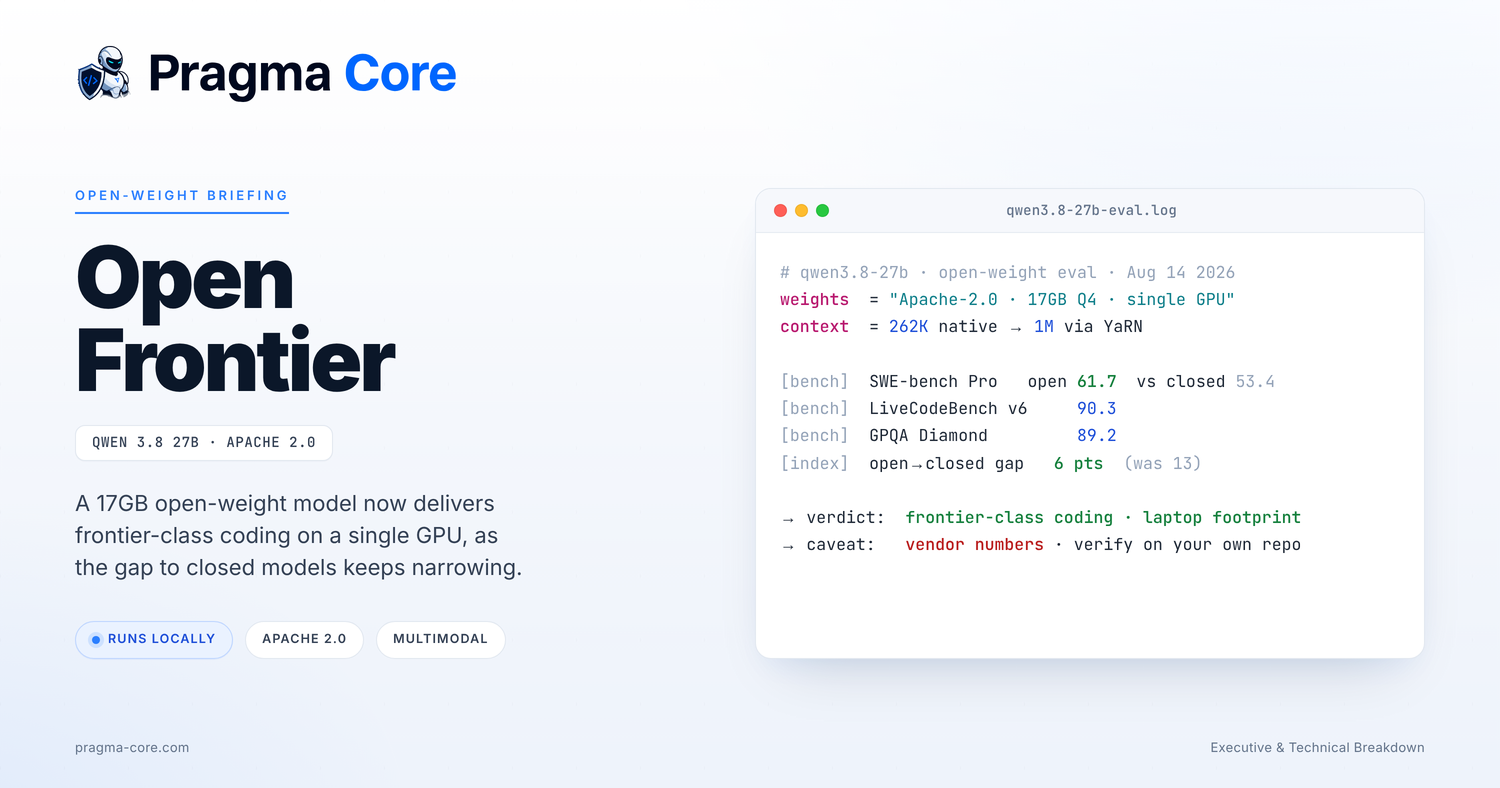
On Friday, August 14, 2026, Alibaba's Qwen team published the weights for Qwen 3.8 27B on Hugging Face under Apache 2.0. Not a preview, not a gated beta, not an API-only tease. A downloadable, self-hostable, natively multimodal dense model that fits on a single consumer GPU and, according to Qwen's own benchmark card, trades blows with a closed flagship many times its size. Within 38 minutes one observer reported more than 10,000 downloads. Within three days the model had been pulled from Hugging Face over 3 million times. The striking part is not any single leaderboard row. It is the shape of the file: a 17GB quantized build that runs on an RTX 3090 or a MacBook now does work that, a year ago, meant renting time on someone else's frontier API.
This article is a two-layered breakdown. The first part is for readers who want to understand quickly what actually shipped and why the "open weights are catching up" story stopped being a slogan and became a measurable trend. The second part is the technical dissection: the architecture that makes a 27B dense model punch this far above its parameter class, what the benchmark claims really say, and where the open field sits against the closed frontier in August 2026. The article closes by looking at what this shift means for application security, and how a platform like Pragma Core is built to operate in exactly this new landscape.
Part I. Executive breakdown
What happened
Qwen 3.8 27B is the open-weight sibling of Qwen 3.8-Max, the 2.4-trillion-parameter flagship Alibaba sells through its cloud. Same generation name, entirely different deployment story. Nobody self-hosts a 2.4T model on a workstation. A 27B is a different animal: it fits on a single rented or owned GPU, it fine-tunes on a realistic budget, and its predecessor, Qwen 3.6 27B, was already one of the most-praised local models of the year.
The new release is a dense (not mixture-of-experts) model with 27.78 billion parameters, native understanding of text, images, and video, a 262,144-token context window that stretches to a full million tokens with a scaling trick, and a permissive Apache 2.0 license that allows commercial use and modification. Qwen's own testing reports that it excels at real-world software engineering and office workflows, and that on several coding and computer-use benchmarks it scores close to, and sometimes above, Anthropic's Opus 4.6 Max. Those are the lab's own numbers, and independent verification is still pending. But the direction is unmistakable, and the community reaction (3 million downloads in 72 hours, the number one trending slot on Hugging Face) tells you the market already believes the size-to-capability ratio.
The plain-language version: a capable, multimodal, agent-ready model that used to require a data center now runs inside a laptop, for free, under a license that lets a company put it into production.
The bigger picture: how the open field closed the gap
Qwen 3.8 27B did not happen in isolation. It is the latest and clearest data point in a trend that has been building for eighteen months, and the numbers are no longer subtle.
| Signal | Twelve months ago | Mid-2026 |
|---|---|---|
| Intelligence-index gap, best open vs closed frontier | ~13 points | ~6 points |
| LMArena Elo gap, open vs closed | ~150 points | ~30 points |
| Top open SWE-bench-style coding scores vs Western frontier | Clear gap | Single-digit percentage points |
| Credible open-weight frontier families | DeepSeek, a handful | DeepSeek, Qwen, GLM, Kimi, MiniMax, Llama, Mistral |
A year ago the interesting question about open-weight models was whether they could do serious work at all. By the middle of 2026 the question inverted. The gap between the best open-weight models and the proprietary frontier narrowed to roughly six points on Artificial Analysis's intelligence index, down from thirteen twelve months earlier. On LMArena the Elo distance between open and closed models compressed from about 150 points to about 30. The top open-weight scores on SWE-bench-style suites now sit within single-digit percentage points of the leading Western closed models for everyday engineering work.
The open frontier in mid-2026 is not one lab, it is a crowded, credible field: DeepSeek's V4 line, Zhipu's GLM-5 series, Alibaba's Qwen, Moonshot's Kimi, MiniMax's M3, Meta's Llama 4, and a strong small-model tier led by Google's Gemma and Microsoft's Phi. Several of them ship under MIT or Apache 2.0, meaning commercial use without conditions. One reporting outlet noted GLM-5.2 shipping under MIT and matching or beating a top closed model on repository-scale coding. Kimi crossed into multi-trillion-parameter territory with a million-token context. The pattern repeats across labs: capable models, real licenses, downloadable today.
Why this matters beyond Qwen
The headline "27B beats Opus" is the reach engine, but it is not the important part. The important part is the deployment reality underneath it. When a model of this capability tier fits on hardware a team already owns, the calculus changes for anyone with data-residency constraints: healthcare, finance, legal, government, and any organization that cannot send its source code or its customer data to a third-party API.
This is the structural shift. For two years, "which model should we build on?" had a short answer: a closed, API-only frontier system, rented by the token. In 2026 that is no longer the only answer. The serious stack is becoming a portfolio: closed frontier models for the hardest and highest-risk work, cheaper hosted open-weight APIs for high-volume work, and local open-weight models for privacy, sovereignty, and fallback. Open versus closed stopped being an ideological argument and became an architecture decision made per workload.
There is a second-order effect that matters specifically for security teams, and we return to it in Part II: capability that runs offline runs offline for everyone, including for the people you are defending against.
Recommended actions
- Benchmark on your own tasks, not on the vendor card. Every headline number for Qwen 3.8 27B currently traces to Qwen's own harness. Run the model against your repository, your issues, and your evaluation set before trusting any single figure.
- Treat open-weight adoption as a portfolio decision. Map each workload to the cheapest model that clears the quality bar for that task, and keep a closed frontier model in the route for the hardest, most ambiguous, or most expensive-to-get-wrong work.
- Read the license before you fine-tune. Apache 2.0 and MIT are clean for commercial use; some "open" models carry geographic or threshold clauses. The cheapest moment to find a restrictive clause is before a production dependency forms, not after.
- Inventory where model weights come from and who touched them. A downloadable model is a supply-chain artifact. Stripped-guardrail and re-quantized forks appear within hours of any popular release; know which checkpoint you are actually running.
- Plan for self-hosted AI in your threat model. If capable code and agent models now run air-gapped, assume both your builders and your adversaries have them. Adjust detection and review accordingly.
Part II. Technical breakdown
The architecture that makes 27B punch above its class
The reason a 27B dense model can credibly enter a conversation about frontier coding is architectural, not just a bigger training run. Per the Hugging Face model card, Qwen 3.8 27B uses a 5120 hidden dimension across 64 layers, but the layer stack is not a uniform transformer. It uses a Hybrid Attention Layout: sixteen repeats of three Gated DeltaNet-plus-FFN blocks followed by one Gated Attention-plus-FFN block. In plain terms, most layers use a linear-attention mechanism that scales cheaply with context length, and a smaller number of full-attention layers preserve the modeling power that linear attention gives up. The mix is what buys both the 262K native context and the efficient footprint at the same time.
On top of that, the model ships with Multi-Token Prediction (MTP), trained across multiple steps. Downstream quantization maintainers exploit MTP for speculative decoding, which is part of why community builds report usable throughput on modest hardware. The native 262,144-token window extends to a full 1,000,000 tokens using YaRN, a context-scaling technique applied at a factor of four over the native window in the reference serving scripts.
The practical result of these choices is the number everyone actually cares about: the model runs on roughly 16 to 17GB of RAM or VRAM via dynamic 4-bit GGUF builds, fitting on a single consumer GPU like a 3090 or 4090, or a well-specced laptop. A 27B-class dense model needs roughly 56GB at full precision, about 28GB at 8-bit, and 14 to 16GB at 4-bit before the KV cache. The 4-bit path is what turns a research artifact into something a small team can actually serve.
The benchmark claims, and the asterisk on every one of them
Qwen's own card reports figures that are genuinely eye-opening for the size class: SWE-bench Pro at 61.7 (against 53.4 for Opus 4.6 Max in the same card), DeepSWE 1.1 at 42.2 (up from 13.3 in the prior generation), LiveCodeBench v6 at 90.3, GPQA Diamond at 89.2, Terminal-Bench 2.1 at 73.0 (up from 63.4), and OSWorld-Verified at 84.3 (up from 63.9). On the vision side, third-party summaries cite OmniDocBench 1.5 around 91 and AndroidWorld around 82.
Here is the distinction that separates a useful reading from a credulous one. All of these numbers currently originate from the lab that built the model. As one hands-on reviewer put it, the self-reported benchmarks are eye-opening, and it will be interesting to hear what independent benchmarks say. Independent leaderboards had not yet updated to include the model at the time of the early coverage. So the honest position on launch weekend was: extraordinary vendor claims, real and verifiable deployment story, and independent capability verification still outstanding. That gap between "the lab says" and "third parties confirm" is not a Qwen problem; it is the default state of every benchmark headline on release day, and it is worth internalizing as a habit.
The over-thinking problem: a warning about defaults
The most useful independent observation in the early signal was not a benchmark at all. It was about the model's factory settings. Qwen 3.8 27B exposes a reasoning system the team calls Flexible Thinking Control, with a Reasoning Effort dial set to xhigh, medium, and low, plus a Preserve Thinking flag that decides whether reasoning blocks from earlier turns are kept in context.
The default is xhigh, and it over-thinks aggressively. In one hands-on test, the classic "draw an SVG of a pelican on a bicycle" prompt at the default setting took 21 minutes and burned 22,276 reasoning tokens to produce roughly 3,200 tokens of output; the same prompt with reasoning turned off produced comparable output in about 137 seconds. Asked simply to draw a circle, the model's reasoning trace started deliberating over concentric guide circles, tick marks, and "restrained ambient motion." There is also a practical trap: some tooling defaults to an 8,192-token context, which the model can exhaust on its own reasoning before it ever answers. Loading the full context window resolves it.
The lesson generalizes past one model: a reasoning dial is only as good as its default, and the shipped default here sits at the far, expensive end of the range. If you evaluate this class of model, override the defaults first, set effort to medium or low for routine work, and reserve maximum effort for genuinely hard problems.
Open weight is not open source
A precise term matters here, because the two get conflated constantly. Qwen 3.8 27B is open-weight: the trained weights are free to download, run, and fine-tune under Apache 2.0. That is a large and real freedom. It is not the same as open-source in the strict sense, because the training data and full training code are not released. You own a copy you can run anywhere; you cannot fully reproduce the training run. This is the norm at the frontier, because reproducing a frontier training run is enormously expensive. The important consequence for a security or compliance team is that "open" gives you deployment control and inspectability of behavior, not a guarantee about how the model was made or what went into it.
The field around it
Qwen 3.8 27B reads differently once you see the company it keeps. DeepSeek's V4 line pushed near-frontier reasoning at aggressive prices and million-token context. Zhipu's GLM-5 series shipped under MIT and, by several accounts, closed the gap to the closed frontier on coding and agent tasks. Moonshot's Kimi reached multi-trillion-parameter scale with native vision and long-horizon agent work. The through-line is that the hardest reasoning and the deepest agent loops still tilt toward the top closed Western tiers, where a wrong answer that costs developer time can make the frontier model cheaper overall. But for everyday engineering, extraction, routing, and high-volume automation, the open field is now good enough that the choice is economic, not qualitative.
A note on independent verification
The healthiest way to treat a release like this is to reproduce the claim, not repeat it. The benchmarks the lab cites are a starting hypothesis, not a conclusion. The signals worth waiting for are the first credible third-party runs on the same suites, real throughput measured at a sensible reasoning setting rather than the over-thinking default, and long-context fidelity checked at the extended window against native-context quality. Until those land, the correct stance is directional confidence in the deployment story and reserved judgment on the frontier-parity claim.
What we should learn from the Qwen 3.8 27B moment
- Capability is decoupling from scale. The story here is not a bigger model; it is architectural efficiency (hybrid linear-and-full attention, multi-token prediction, aggressive quantization) delivering frontier-adjacent behavior at a footprint a single GPU can hold. Plan for capability to keep arriving in smaller packages.
- A downloadable model is a supply-chain artifact. The moment weights are public, forks appear: re-quantized builds, fine-tunes, and stripped-guardrail variants within hours. Provenance of the exact checkpoint you run matters as much as provenance of a dependency in your lockfile.
- Vendor benchmarks are a hypothesis, not a verdict. Every headline number on launch day traced to the lab that built the model. Build the habit of separating "the maker claims" from "third parties confirmed," and measure on your own tasks before you trust a leaderboard.
- Defaults are a security and cost surface. A reasoning dial pinned to its most expensive setting can burn twenty thousand tokens on a trivial prompt. The gap between a model's factory settings and its correct production settings is real, and it is your responsibility to close.
- Offline capability is symmetric. A model good enough to accelerate your engineers, running air-gapped and unlogged, is equally available to an adversary. The rise of capable local models belongs in the threat model, not just the productivity roadmap.
How Pragma Core addresses this class of problem
Pragma Core is a continuous, AI-driven application security platform built by zer0day Technologies and Expertware. The open-weight surge is not a side story for a platform like this; it is the operating environment. When frontier-adjacent capability becomes self-hostable, the questions that matter for AppSec are exactly the ones Pragma Core is designed around: where does your code go when a model reasons over it, which model version and provenance is actually running, and how do you use this capability to find fragile code faster than the people trying to exploit it. The following capabilities map directly onto the shift Qwen 3.8 27B represents.
AI security research that runs where your code lives
Pragma Core's autonomous agents investigate attack chains, reasoning over how input and state flow across functions, services, and trust boundaries rather than stopping at a single flagged line. The open-weight trend is what makes this practical for organizations that cannot ship source to a public API: capable models that run inside a private network mean the analysis can happen next to the code instead of leaving it. For a bank, a hospital, or a government team, that is the difference between adopting AI-driven review and being blocked by data residency.
Native repository integration without sending source outside the perimeter
Pragma Core connects to GitHub, GitLab, and Azure DevOps in minutes, and continuous scanning starts immediately with findings contextualized by repository, branch, and commit. In a world where the underlying models can be hosted privately, that integration path does not have to mean handing your entire codebase to an external provider. The same architecture shift that put Qwen 3.8 27B on a laptop is what lets a security platform meet strict-perimeter teams where they are.
Supply-chain and provenance tracking, extended to models
Pragma Core tracks third-party components across every connected repository, surfacing vulnerable versions and fix paths, including dependencies buried in containers and appliances. The open-weight era adds a new artifact class to that inventory: the model weights themselves. Stripped-guardrail and re-quantized forks of popular releases appear within hours, and "which checkpoint are we actually running, and who modified it" becomes a supply-chain question with the same shape as any other dependency. The discipline Pragma Core applies to packages is the discipline this new artifact needs.
SAST tuned for how code actually connects, not just injection sinks
Off-the-shelf static analysis is tuned for taint flows that end in a SQL or shell sink and misses logic, authorization, and state-mismatch bugs. As AI-assisted and AI-generated code enters repositories at higher volume (a direct consequence of cheap, capable, self-hostable models), the bugs that slip through are increasingly about relationships between functions, not a single bad line. Pragma Core's static analysis and interactive call graphs are built to surface exactly those cross-function and cross-service relationships.
Human-guided investigations for what the team feels is fragile
The expert-led research module lets an AppSec operator drive deeper analysis, backed by autonomous agents and the context already in the workspace. As teams fold local models into their build and review pipelines, the surface that feels fragile shifts: new tooling, new defaults, new failure modes like the over-thinking behavior above. Pragma Core makes that kind of targeted, human-directed investigation a systematic part of the subscription rather than a one-off engagement.
Closing thoughts
The Qwen 3.8 27B release is not, fundamentally, a story about one model beating one benchmark. It is a story about capability leaving the data center. When frontier-adjacent behavior fits in a 17GB file under a permissive license, the constraints that used to shape every AI decision (who hosts the model, where your data goes, what you are allowed to run) loosen all at once, for defenders and adversaries alike. The same shift that lets a healthcare team finally run AI-assisted code review inside its own network also puts a capable, uncensorable coding model on any laptop. That symmetry is the real headline.
The organizations that will handle this well are the ones that already treat their code and dependencies as things to be continuously investigated rather than periodically scanned. The gap between reading a release like this as a curiosity and using it as a trigger to audit what is fragile in your own stack comes down to AppSec maturity and code visibility. Teams that want to move from "we scan and report" to "we systematically investigate what is fragile," with AI-driven research that can run where their code actually lives, can reach Pragma Core at pragma-core.com for a demo.
Sources
- Qwen 3.8 27B official model card, Hugging Face (Qwen/Qwen3.8-27B), released August 14, 2026.
- Kie.ai, Qwen 3.8 27B Release: A Deep Dive, August 17, 2026.
- Simon Willison, Qwen 3.8 27B is excellent, but it defaults to wildly overthinking things, August 16, 2026.
- Cybernews, Qwen3.8-27B arrives free, already downloaded over 3 million times, August 2026.
- Local AI Zone, Qwen3.8-27B: A Comprehensive Technical Analysis, August 2026.
- Digiwit, The best open-weight models in 2026, ranked, July 13, 2026.
- Information Security Media Group (GovInfoSecurity), Chinese AI Models Narrow Gap With US Frontier Labs, August 4, 2026.
- GEO Toolbox, Chinese AI Models Compared: DeepSeek, Qwen, GLM, Kimi (2026), August 2026.